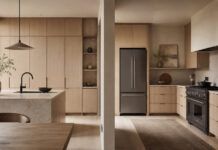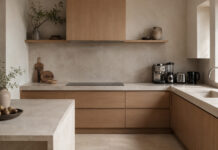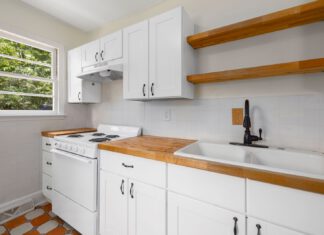


To give a kitchen more character, start with the part you notice most: the island, a blank wall, the handles or the lighting. Choose one change that works with the room you already have before planning a larger replacement.
Keep a photograph and a few measurements beside your samples. Check choices in the kitchen’s daylight and evening light, and consider how you will clean and use them. These seven ideas offer different levels of work; you do not need to apply them all.
1. Make the island a deliberate colour choice
If you have an island, try a finish that differs from the surrounding cabinets. Compare a sample with the floor, worktop and existing cabinet colour. Decide whether the island should stand out or sit quietly within the room.
Ask whether the existing surface is suitable for the proposed coating and what preparation it needs. Include the side panels and visible edges in the quote so the change looks intentional from the dining area as well as from the sink.
2. Put artwork where it can be enjoyed and maintained
Use a dining corner or another wall away from cooking equipment for a picture, print or family photograph. Check the position from where you sit and work. Choose a display you can reach to clean without stretching over an appliance.
The U.S. Fire Administration’s cooking guidance says to keep things that can burn away from the cooking area. A moisture-resistant frame does not make artwork suitable for a position beside a flame or hot appliance. Follow the appliance’s clearance instructions.
3. Choose one patterned surface
A patterned floor or wall finish can be the room’s main decorative feature. Compare a large enough sample to see how the pattern repeats. Place it beside the worktop and cabinet samples before ordering.
Check the product’s intended use, installation requirements and care instructions for the actual location. A tile suitable for a wall is not automatically a suitable kitchen floor. Ask for a quote that includes preparation, fitting and finishing rather than judging the project by the material price alone.
4. Change handles with the existing doors in mind
Measure the distance between the existing fixing holes before choosing new pulls. Check the base size as well: a smaller fitting may reveal marks left by the old hardware. Try one sample on a door or drawer before buying a complete set.
Check the grip with wet hands and make sure neighbouring doors and appliances can still open. A finish that looks good in a close-up photograph also needs to work in daily use.
5. Give lighting a clear role
A pendant can draw attention to an island or eating area, while task lighting serves the work surfaces. Mark the proposed fitting’s size and position before ordering so it does not block conversation or a useful view across the room.
Have an appropriate electrician assess electrical alterations and any unfamiliar or older fitting. Choose fixtures for their intended location and follow the relevant installation and appliance instructions, rather than copying a hanging height from a photograph.
6. Display a small collection on open shelves
Choose a few items that belong in the room, such as everyday crockery or cookbooks. Plan their positions before buying a shelf. Keep enough room to take each item down and wipe the surface.
Check the shelf’s rated load, support and fixing requirements for the wall. Keep the arrangement away from cooking heat and splashes. If you would rather avoid frequent dusting, a glazed cupboard may suit the same collection better.
7. Select stone by its specific properties
A stone surface can add pattern and texture, but “natural stone” is not one uniform material. Ask the supplier to identify the exact material and finish, and explain its cleaning, stain and maintenance requirements for the proposed use.
The Natural Stone Institute’s care guidance explains that some stones are sensitive to acids and that a sealer improves stain resistance rather than making stone stain-proof. Avoid a blanket claim that stone is water-proof, mould-proof or an allergy solution.
Turn the idea into a small, clear project
For the change you choose, keep the sample, dimensions, full quote, installation requirements and care instructions together. Check what needs to happen to the existing finish or fittings. This makes it easier to compare options and avoids starting several changes that do not work together.