
A retaining wall doesn’t suddenly fail without warning. Long before anything collapses, there are signs – subtle shifts, small cracks, a slight lean that’s easy to ignore at first. The problem is that these early signals rarely feel urgent. The wall is still standing, after all. It still looks functional. So the issue gets pushed aside.
That’s usually when the real damage begins.
A leaning wall isn’t just a cosmetic issue. It’s a structural one, and once movement starts, it tends to accelerate rather than stabilise. This is why many homeowners only start looking into solutions like a retaining wall in Perth after the problem becomes difficult to ignore. By then, what could have been a straightforward fix has often turned into a much larger and more expensive repair.
If your wall has started to lean – even slightly – it’s worth understanding what’s happening beneath the surface, and why acting early makes such a difference.
Movement Doesn’t Happen Without a Cause
Retaining walls are built to hold back pressure. Soil, water, and gravity are all working against them constantly. When a wall starts to lean, it’s because something has shifted in that balance.
In many cases, the issue isn’t the wall itself – it’s what’s happening behind it. Soil becomes saturated, drainage fails, or the ground settles unevenly. Over time, that pressure builds until the structure can no longer hold its original position.
What makes this tricky is that the visible lean is often just the end result. The underlying cause may have been developing quietly for months or even years. By the time you notice the movement, the conditions behind the wall have already changed significantly.
That’s why simply correcting the angle without addressing the cause rarely works. The pressure doesn’t disappear – it just pushes back again.
Small Shifts Turn Into Structural Problems
A wall that has moved a few millimetres might not seem like a concern. But retaining walls are designed to distribute load evenly. Once that alignment is disrupted, stress begins to concentrate in specific areas.
That’s when other issues start to appear.
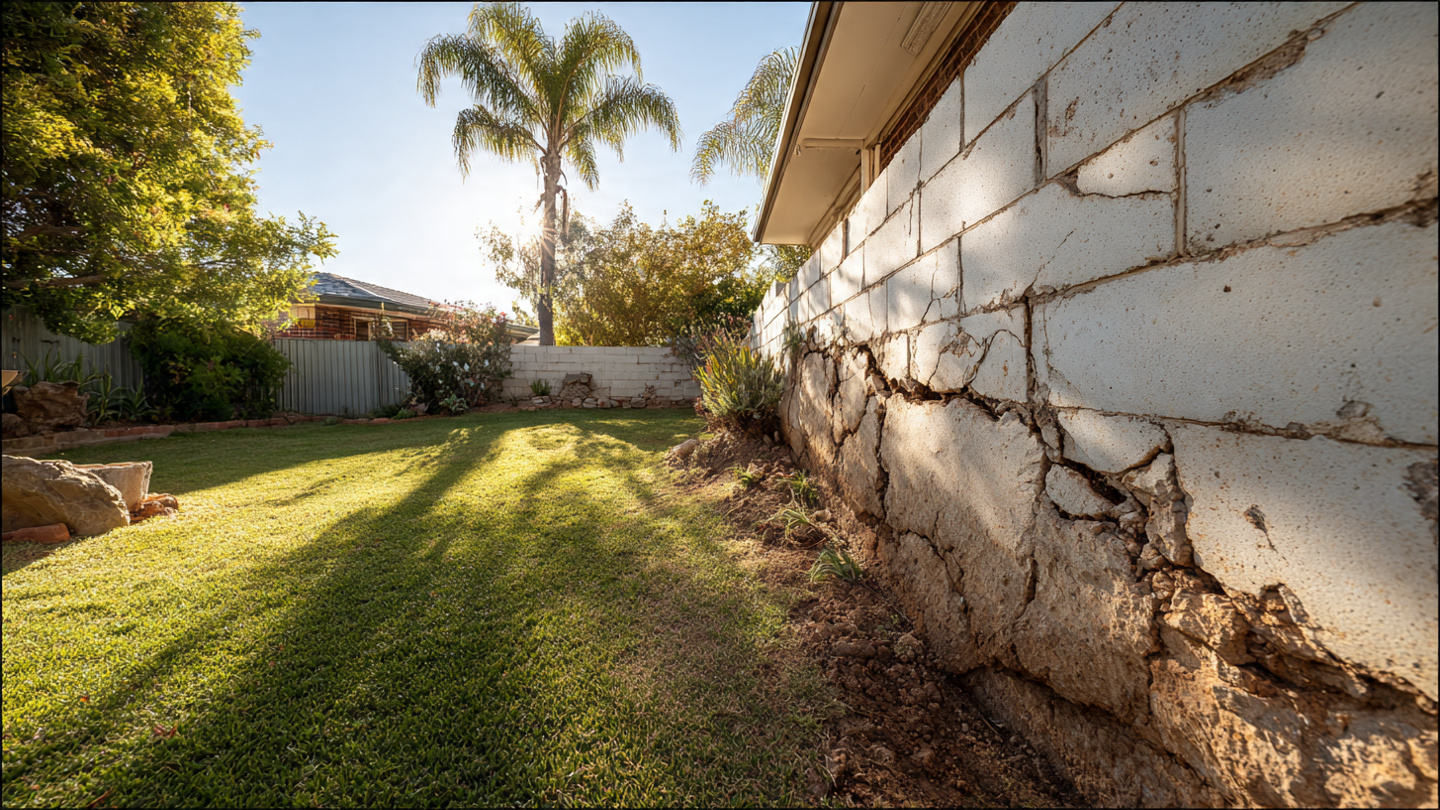
You might notice cracks forming along the surface, gaps opening between blocks, or sections that feel less stable under pressure. These are all signs that the wall is no longer functioning as intended.
Left alone, these small defects tend to expand. What starts as a slight lean can evolve into bowing, separation, or in more severe cases, partial collapse.
The key point is that movement doesn’t pause. It continues, often gradually at first, then more noticeably as the structure weakens.
Water Is Often the Real Problem
One of the most common reasons retaining walls fail is poor drainage.
Water adds weight to soil, increasing the pressure pushing against the wall. It also reduces the soil’s stability, making it more likely to shift. Without proper drainage systems in place, that combination creates conditions that no wall can resist indefinitely.
The challenge is that drainage issues aren’t always visible. Water builds up behind the wall, out of sight, until the effects start to show on the surface.
When a wall begins to lean, it’s often a sign that water has been accumulating for some time. Fixing the wall without addressing drainage is a temporary solution at best. The same conditions will continue to apply pressure, and the problem will return.
Understanding how water moves through your landscape is essential to resolving the issue properly.
Timing Changes the Outcome
There’s a significant difference between correcting early movement and repairing a failed structure.
In the early stages, it may be possible to stabilise the wall, relieve pressure, and restore its position with relatively minimal intervention. Once the structure has deteriorated further, those options become more limited.
At that point, sections may need to be rebuilt entirely. Foundations might require reinforcement. Drainage systems may need to be installed from scratch rather than adjusted.
The longer the issue is left unresolved, the more complex the solution tends to become.
This isn’t about urgency for its own sake. It’s about recognising that structural problems rarely remain static. They progress, and the cost of addressing them usually increases alongside that progression.
Not All Leaning Walls Are the Same
It’s tempting to treat all leaning walls as a single type of problem, but the underlying causes can vary.
Some walls lean because of poor construction. Others because of changing soil conditions. Some are affected by nearby landscaping changes, while others fail due to age and gradual wear.
Understanding which of these factors is at play is what determines the right solution.
A surface-level fix might improve how the wall looks, but it won’t resolve the issue if the cause remains. Proper assessment is what separates a temporary repair from a lasting one.
This is where experience matters – not just in building walls, but in understanding how and why they fail.
The Risk Isn’t Always Obvious
A leaning wall can seem stable right up until it isn’t.
Because movement often happens slowly, it’s easy to underestimate the level of risk. The wall might hold its position for weeks or months, giving the impression that the issue isn’t urgent.
But structural failure doesn’t always follow a gradual timeline. Once pressure exceeds what the wall can handle, failure can happen quickly.
This is particularly important in areas where the wall is supporting elevated ground, pathways, or structures. The consequences of failure extend beyond the wall itself.
Even when the risk appears low, it’s worth taking the situation seriously.
Repairing the Problem Properly
Fixing a leaning retaining wall isn’t about forcing it back into place. It’s about restoring the conditions that allow it to function correctly.
That usually involves reducing the pressure behind the wall, improving drainage, and ensuring the foundation is stable. In some cases, it also means reinforcing or rebuilding sections that have already been compromised.
The approach depends on how far the issue has progressed and what caused it in the first place.
What matters is that the solution addresses both the visible problem and the underlying conditions. Anything less is likely to be temporary.
Acting Before It Becomes a Bigger Issue
Retaining walls are designed to be durable, but they rely on the environment around them remaining stable. When that environment changes, the wall responds.
A lean is one of the clearest signals that something isn’t right.
Responding early doesn’t just protect the wall itself. It prevents additional damage to surrounding areas and reduces the likelihood of more extensive work later on.
Ignoring the issue, on the other hand, allows the problem to develop further – often quietly, until it reaches a point where the solution becomes more disruptive and more expensive than it needed to be.
Recognising that difference is what helps you make the right decision at the right time.