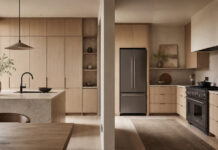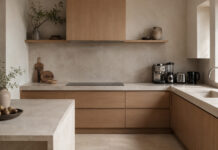

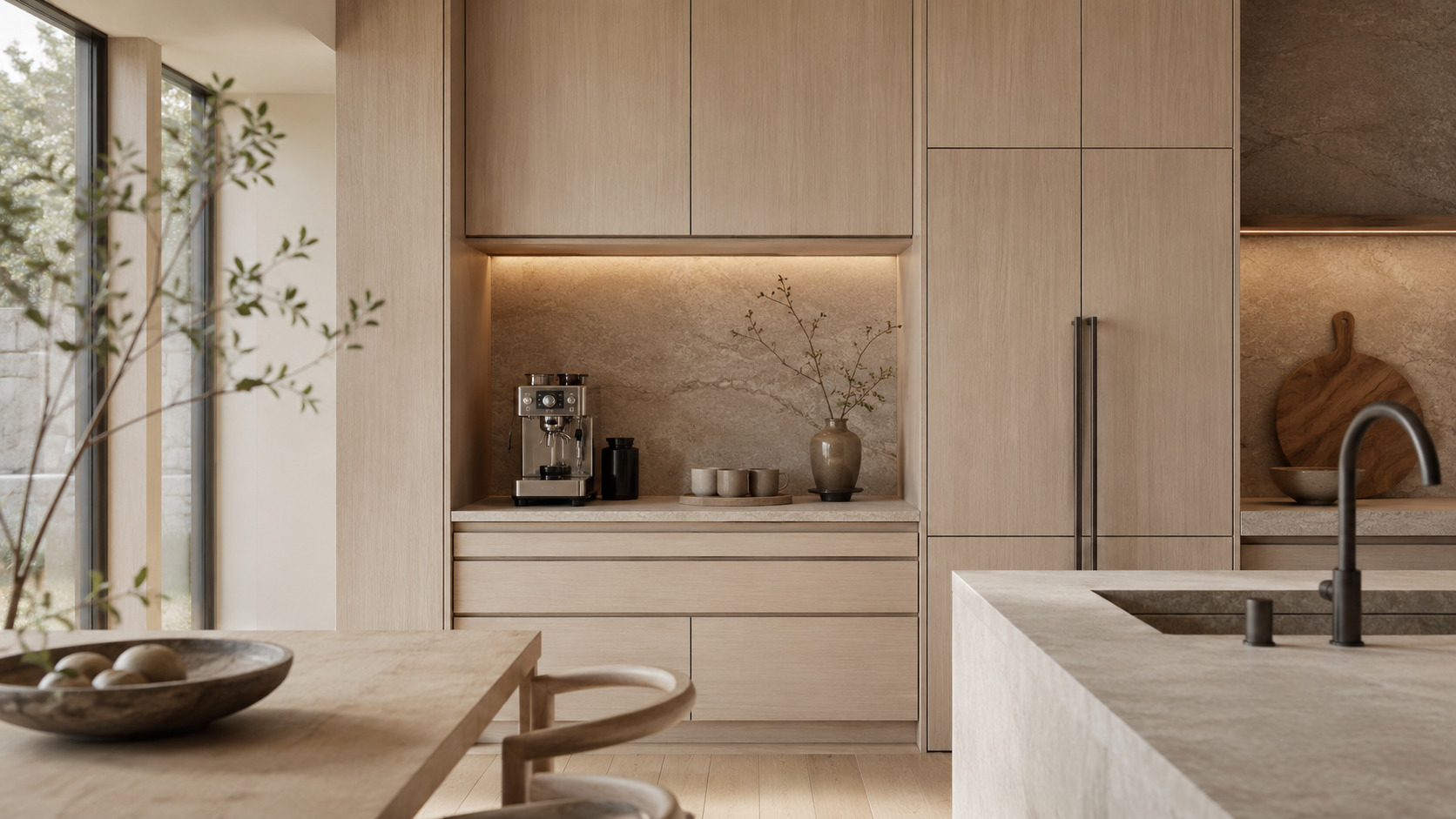
A calm kitchen can lose its sense of order surprisingly quickly.
The cabinets may be beautifully coordinated, the worktops carefully cleared, and the color palette intentionally restrained. Yet one corner often becomes crowded with a coffee machine, grinder, bean bags, mugs, spoons, syrups, filters, and electrical cords.
The problem is not necessarily the amount of equipment. It is the absence of a clear place for the daily coffee routine.
A well-designed coffee station brings those activities together within one compact and practical zone. The machine is easy to refill, cups are close at hand, small tools have a logical home, and the work surface remains simple to clean after use.
In a Japandi kitchen, this practical arrangement is softened by natural wood, muted colors, handmade ceramics, subtle lighting, and carefully controlled visual detail. The space should feel warm without becoming decorative and minimal without making the morning routine inconvenient.
The most successful Japandi coffee station ideas begin with function. Styling comes afterward.
Key Takeaways
- Design the station around the way you actually prepare coffee, rather than copying a styled photograph.
- Combine natural wood, quiet stone, matte ceramics, and softly textured materials.
- Keep daily equipment accessible while placing packaging and backup supplies behind closed doors.
- Plan electrical outlets, ventilation, lighting, water access, and cleaning space before installing cabinetry.
- Leave enough clear worktop for filling, pouring, preparing, and wiping down the machine.
Table of Contents
- What Makes a Coffee Station Japandi?
- Plan Around Your Coffee Routine
- 12 Japandi Coffee Station Ideas
- Common Coffee Station Mistakes and How to Fix Them
- Frequently Asked Questions
- Create a Calmer Morning Routine
What Makes a Coffee Station Japandi?
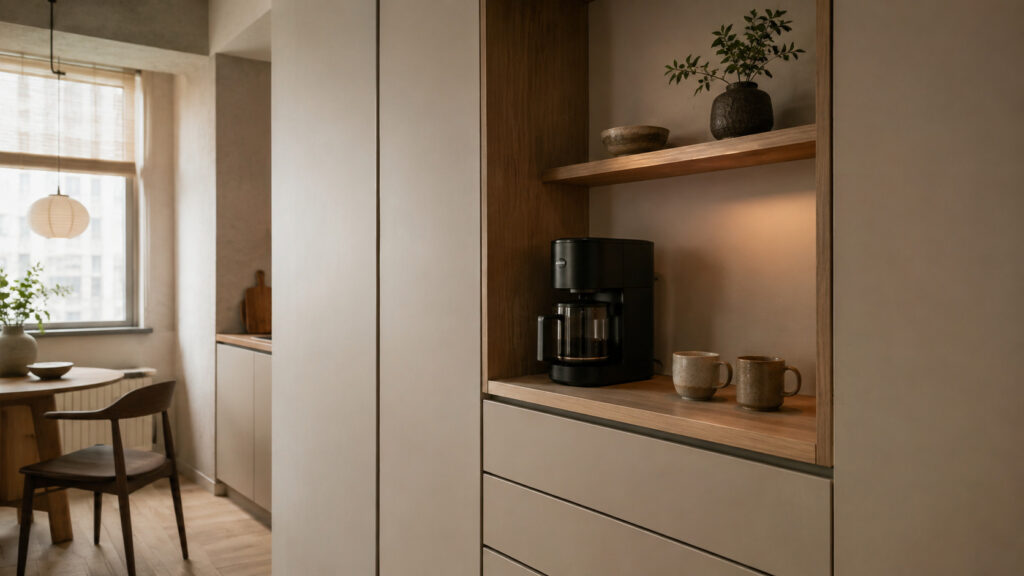
Japandi design brings together the visual restraint associated with Japanese interiors and the softer comfort commonly found in Scandinavian homes.
In practical terms, this usually means clean forms, useful objects, natural materials, muted colors, visible craftsmanship, and enough negative space to prevent the room from feeling crowded.
A Japandi coffee station does not need to be completely empty. The espresso machine, kettle, grinder, or a favorite handmade mug may remain visible when those objects are used regularly and contribute to the experience of the space.
The key is intentional visibility.
Instead of displaying every packet, appliance, cup, and accessory, select only the items that support the daily routine or have genuine visual value. Store the remaining supplies in nearby drawers, cabinets, baskets, or pantry shelves.
The NKBA 2026 kitchen trends report notes continued interest in visible wood grain, white oak, natural light, task lighting, and discreet technology. These features fit naturally within Japandi interiors, but they work best when they improve long-term usability rather than being added only because they are currently popular.
A convincing Japandi coffee corner should therefore feel:
- Simple, but not empty
- Warm, but not heavily decorated
- Organized, but not overly formal
- Functional, but still visually calm
Plan Around Your Coffee Routine
Before choosing shelves, trays, cabinet finishes, or decorative mugs, think through an ordinary morning.
What do you reach for first?
Where does the water come from?
Where do you place the cup while grinding beans?
What happens to used filters, coffee grounds, wet spoons, or milk pitchers?
Where will the machine be cleaned and refilled?
These small movements determine whether the station will feel effortless or frustrating.
An espresso setup may require space for a grinder, tamper, scale, knock box, milk pitcher, cleaning brush, and spare beans. A pour-over station may need a kettle, dripper, paper filters, server, measuring spoon, and several containers.
Designing only around the dimensions of the coffee machine can leave the surrounding routine without enough space.
Measure every appliance with the water tank, bean hopper, lid, drip tray, and access panels fully open. Check the manufacturer’s instructions for ventilation and required clearance. Confirm that the machine can be moved forward when it needs cleaning or maintenance.
Frequently used cups, beans, spoons, and filters should ideally be accessible within one or two simple movements from the main preparation surface.
| Station Format | Best For | Main Advantage | Important Consideration |
|---|---|---|---|
| Open counter niche | Frequent daily use | Fast and convenient access | The equipment remains visible |
| Appliance garage | Minimalist and open-plan kitchens | Hides visual clutter after use | Requires suitable ventilation and outlets |
| Tall cabinet station | Larger kitchens and renovations | Provides integrated storage | Internal layout must be carefully planned |
| Freestanding trolley | Renters and compact homes | Flexible and movable | Usually offers less concealed storage |
12 Japandi Coffee Station Ideas
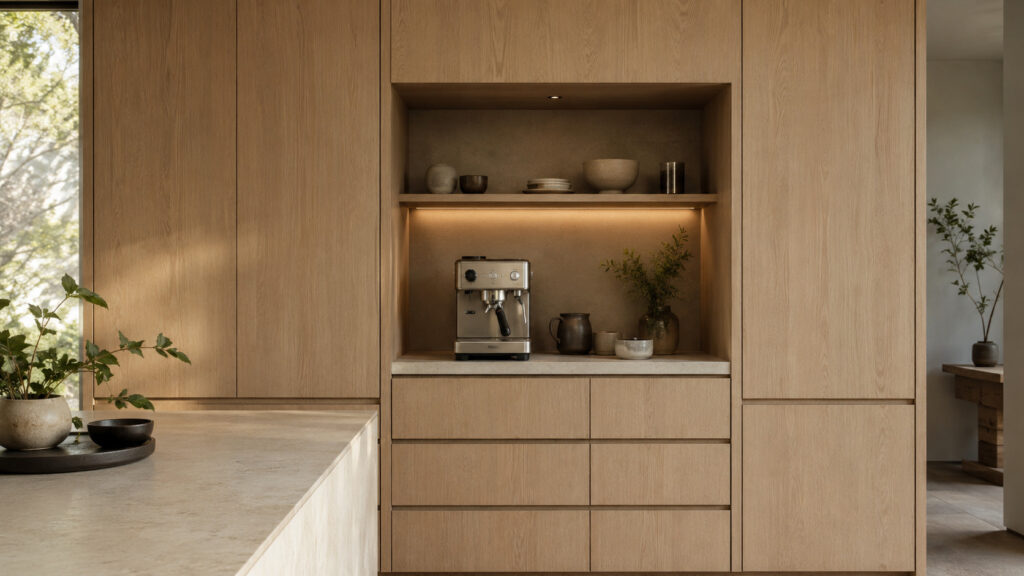
1. Frame the Coffee Station with Pale Oak
Pale white oak or light ash can visually separate the coffee station from the rest of the kitchen without creating a harsh contrast.
Use the timber on flat cabinet fronts, the inside of a recessed niche, a floating shelf, or a narrow section of wall paneling. The visible grain adds warmth and depth while allowing the overall composition to remain simple.
A matte or low-sheen finish usually suits Japandi interiors better than a highly polished coating. It preserves the natural appearance of the wood and reduces distracting reflections.
The wider appeal of oak kitchen cabinets comes from their durability, visible texture, and ability to work with both modern and traditional elements.
For a quieter Japandi interpretation, choose relatively consistent grain patterns and combine them with:
- Handle-free cabinet fronts
- Small timber pulls
- Simple dark metal hardware
- Warm white or taupe surrounding cabinetry
The wood should provide warmth, not become the busiest visual element in the room.
2. Conceal the Equipment Inside an Appliance Garage
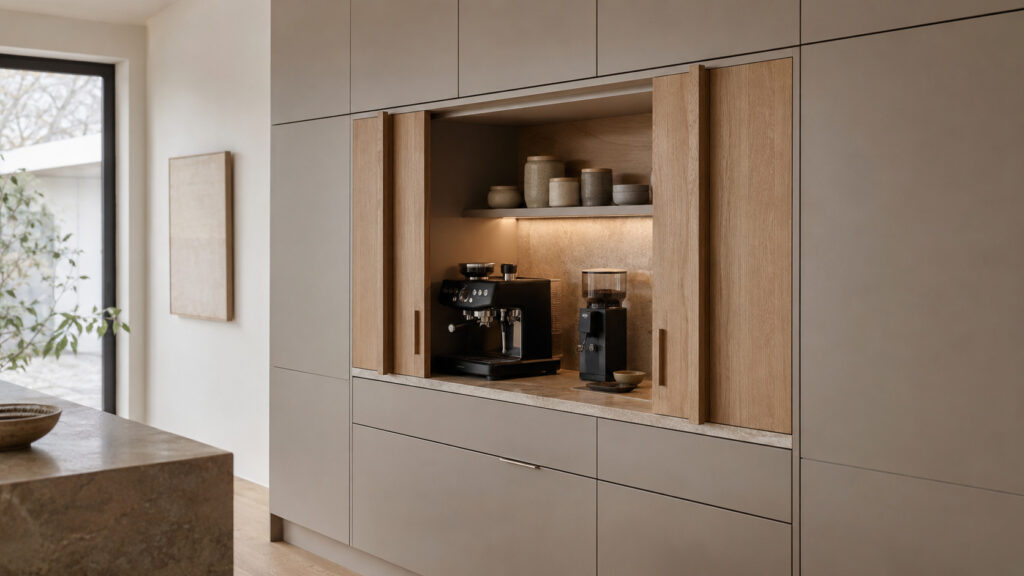
An appliance garage allows the coffee station to remain fully accessible during breakfast and disappear once the routine is finished.
Pocket doors, lift-up fronts, folding panels, and retractable doors can hide the machine, grinder, cups, and small containers behind the surrounding cabinetry.
This is particularly useful when the kitchen opens directly into a dining or living room. Closing the doors after use restores a calmer visual background without requiring the equipment to be moved each day.
The cabinet must not be treated as an ordinary storage box. Coffee machines, kettles, and other heat-producing appliances may require airflow and clearance around the sides, rear, and top.
Follow the manufacturer’s operating instructions. Unless the system was specifically designed for enclosed operation, the doors should remain fully open while the appliance is running.
3. Transform an Awkward Corner into a Compact Coffee Niche
A dedicated coffee bar does not always require a complete wall of cabinetry.
An unused section beside the refrigerator, pantry, dining entrance, or end of a kitchen run may provide enough width for a compact machine and a small preparation surface.
Instead of adding bulky furniture, define the corner through one controlled design change. This could be:
- A different backsplash material
- A shallow floating shelf
- A recessed cabinet niche
- A focused pool of task lighting
- A timber panel behind the machine
Place the machine toward the rear of the counter while leaving open space in front or beside it. That clear area is needed for setting down cups, measuring coffee, pouring milk, and wiping spills.
A removable tray can visually group sugar, spoons, and small jars. Select one that can be lifted easily and cleaned underneath.
4. Balance Warm Wood with Quiet Stone
Japandi minimalism becomes more welcoming when it is supported by texture.
Pair pale oak with honed limestone, warm-gray quartz, travertine-inspired porcelain, or a soft concrete-look surface. These materials create depth without relying on strong colors or decorative patterns.
The most important principle is restraint.
If the wood has a pronounced grain, choose a counter and backsplash with limited movement. If the stone has visible veins or tonal variation, keep the cabinetry flat and simple.
Using several expressive materials in a small niche can make the station feel visually crowded even when only a few objects are displayed.
Controlled contrast creates a more layered result:
- Warm timber against muted gray stone
- Matte ceramic against smooth cabinetry
- Dark metal details against pale natural surfaces
5. Keep Open Shelving Deliberately Limited
One slim floating shelf can make a coffee station feel complete without filling the wall.
Use it for a small number of objects that support the daily ritual, such as two or three mugs, one coffee container, and perhaps a handmade vase or sculptural branch.
The shelf becomes less effective when it is expected to store every spare cup, syrup bottle, tea packet, and souvenir mug.
Japandi styling depends on editing. It is not enough to arrange many objects neatly.
Move excess supplies into:
- A drawer beneath the counter
- A nearby pantry cabinet
- A closed wall cabinet
- A woven basket inside a lower shelf
Leave some visible space between objects so the composition can breathe.
6. Add a Drawer for Small Preparation Tools
Small coffee tools are easy to lose and difficult to organize on an open counter.
A shallow drawer directly beneath the machine can hold spoons, filters, scales, tea infusers, cleaning brushes, reusable capsules, and other compact accessories.
Use simple dividers so each item has a predictable location. This prevents the drawer from becoming another cluttered container hidden behind a clean cabinet front.
A deeper drawer below can store:
- Unopened coffee beans
- Tea boxes
- Spare mugs
- Cleaning tablets
- Extra filters
- Small towels
Keeping the supporting supplies vertically aligned with the machine reduces unnecessary movement across the kitchen.
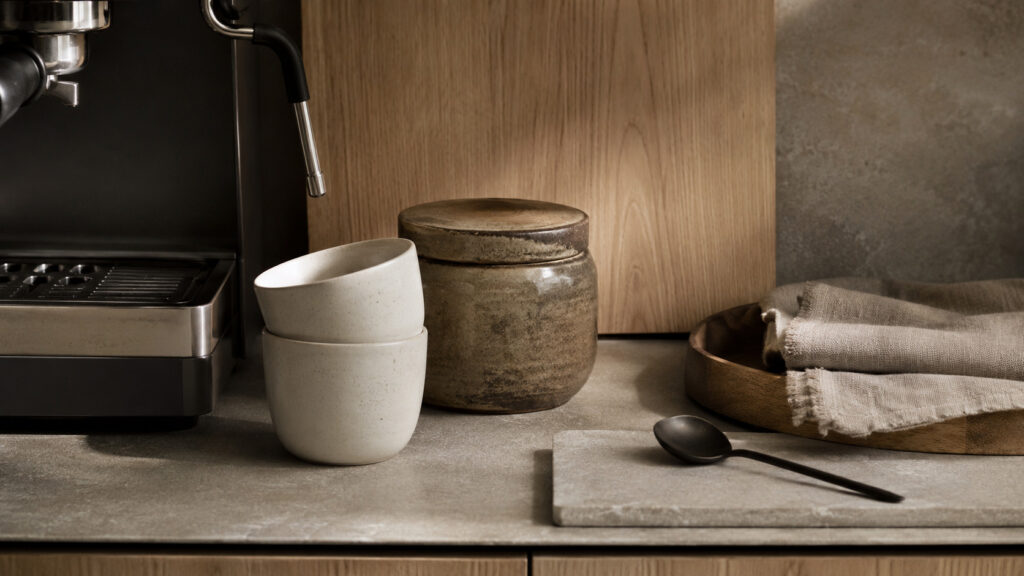
7. Let Handmade Ceramics Provide the Decoration
Japandi interiors often find beauty in slight irregularity rather than perfect uniformity.
A pair of handmade stoneware mugs, a softly textured sugar bowl, or a simple clay container can add character without introducing bright colors or printed signs.
These pieces should remain functional. Choose ceramics that are comfortable to hold, stable on the shelf, and suitable for regular washing.
A small group of objects used every day will feel more authentic than a collection purchased only to fill the space.
To keep the shelf visually connected, repeat one or two qualities rather than matching every object exactly. The pieces might share:
- A warm off-white color
- A matte glaze
- A similar clay tone
- A softly rounded shape
The result should feel collected and natural, not staged.
8. Improve the Routine with a Simple Water Zone
Water access often determines how practical a coffee station feels.
A station positioned close to the main sink makes it easier to refill the machine, rinse milk pitchers, wash spoons, and empty drip trays. A nearby filtered-water tap can further simplify the routine.
In a large renovation, a compact preparation sink may be useful, but it also introduces additional plumbing, maintenance, cost, and counter-space requirements.
For many kitchens, a removable water jug placed in a nearby cabinet is the more realistic solution.
Protect timber and cabinet joints from repeated moisture. Use a sealed counter, washable tray, or moisture-resistant surface beneath the machine and water container. Wipe splashes promptly rather than allowing water to collect behind the equipment.
9. Light the Preparation Surface
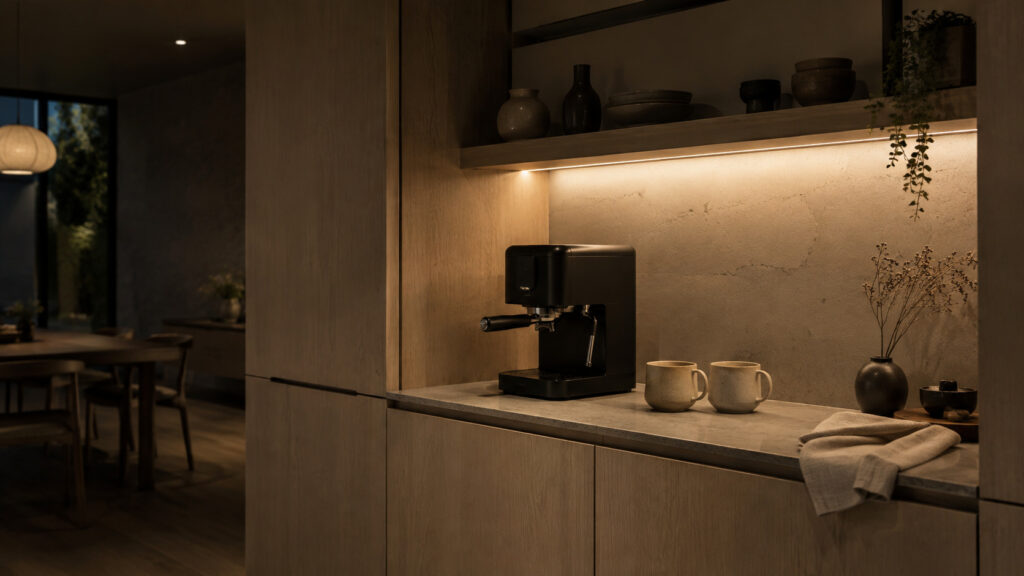
Coffee stations are frequently used early in the morning or after the main kitchen lighting has been dimmed.
A concealed LED strip or integrated cabinet light can illuminate the work surface without making the entire room feel overly bright.
The light should make it easier to:
- Measure coffee
- Read controls
- Pour water or milk
- Notice spills
- Clean the machine
Position the light toward the front edge of the upper cabinet. If it sits too close to the wall, the user may cast a shadow directly across the preparation area.
Warm or neutral-white illumination generally works well with oak, stone, and ceramic. A dimmer can be useful when the coffee station is visible from an adjoining living space.
10. Plan the Outlets Before Hiding the Cords
Visible cords can make an otherwise controlled coffee station look unfinished.
Place outlets behind or beside the appliances so the cords remain short and discreet. However, the plugs should still be accessible when the machine needs maintenance, cleaning, or replacement.
Avoid creating such a tight fit that the equipment crushes the cable against the wall.
A qualified electrician should install new outlets, concealed wiring, or electrical connections close to sinks and other water sources according to local regulations.
The Electrical Safety Foundation International recommends connecting appliances directly to appropriate wall outlets and using extension cords only as temporary solutions.
Do not overload adapters, conceal permanent extension cords inside cabinetry, or route electrical cables through damp areas.
11. Soften the Station with Fluted Glass or Linen
Solid cabinet doors are not the only way to conceal a coffee corner.
A fluted-glass panel can reduce visual noise while still allowing light and vague silhouettes to pass through. This works particularly well when the surrounding kitchen already includes glass-fronted storage or subtle vertical details.
A short linen curtain offers a softer and more affordable alternative. It can conceal lower shelves or a freestanding station while introducing a natural textile.
Both options require practical consideration.
Keep fabric away from hot appliances, steam vents, flames, and electrical connections. Choose washable material because coffee dust, water droplets, and milk splashes will eventually reach nearby surfaces.
Textured glass should also be easy to open and clean.
12. Create a Freestanding Coffee Station for More Flexibility
Renters and homeowners who are not ready to alter their cabinetry can create a Japandi coffee station using freestanding furniture.
A narrow timber console, compact trolley, or vintage cabinet with simple proportions can provide the required surface and storage.
To keep the arrangement connected to the kitchen, repeat materials already present in the room. For example:
- Choose timber similar to the cabinet finish
- Add a stone or sealed tray that relates to the worktop
- Use baskets in the same neutral palette
- Select ceramics that repeat the kitchen’s warm whites and grays
Check that the furniture can safely support the combined weight of the machine, grinder, water reservoir, cups, and stored supplies.
Tall, narrow, or mobile pieces may require wheel locks or suitable wall anchoring, especially in homes with children or pets.
Common Coffee Station Mistakes and How to Fix Them
A coffee corner can look attractive in a photograph and still be inconvenient in everyday use. These common mistakes usually appear when styling decisions are made before workflow and safety are considered.
Prioritizing Appearance Over the Routine
The problem: The machine looks centered and balanced, but cups, water, beans, and waste are stored in different parts of the kitchen.
The fix: Arrange the station as a simple sequence: water, coffee, preparation, serving, and cleanup.
Measuring Only the Closed Appliance
The problem: The machine fits inside the niche, but the water tank, lid, or bean hopper cannot open fully.
The fix: Measure the appliance in use, including all removable parts and access panels.
Displaying Every Accessory
The problem: The shelf is filled with jars, signs, packets, syrups, and decorative objects.
The fix: Leave only frequently used or meaningful items visible. Store backups and packaging behind closed doors.
Using Unprotected Timber Near Water
The problem: Splashes and condensation repeatedly reach unfinished wood.
The fix: Use an appropriately sealed surface, protect vulnerable joints, and wipe moisture promptly.
Forgetting Cleaning and Maintenance Access
The problem: The machine is fitted so tightly that the wall, drip tray, and rear surface cannot be reached.
The fix: Leave room to move the appliance forward and clean around it.
Relying on Permanent Extension Cords
The problem: Multiple appliances are connected through adapters hidden inside the cabinetry.
The fix: Ask a qualified electrician to provide suitable permanent outlets in safe and accessible positions.
Adding Too Many Competing Materials
The problem: Strong wood grain, dramatic stone, patterned tile, dark metal, and colorful accessories all compete within a small niche.
The fix: Select one dominant natural texture and allow the remaining materials to stay quiet.
Frequently Asked Questions
How much counter space does a coffee station need?
The amount of space depends on the equipment and preparation method.
A small pod machine or pour-over setup may fit on a narrow section of counter. An espresso machine with a separate grinder, tamper, milk pitcher, and knock box requires significantly more width and depth.
Measure every appliance and leave a clear working area in front or beside the equipment. Check the manufacturer’s required rear, side, and overhead clearances before ordering cabinets or shelves.
What colors work best for a Japandi coffee corner?
Warm white, oatmeal, sand, mushroom, taupe, muted gray, pale oak, and medium brown provide a reliable foundation.
Small amounts of black or charcoal can add definition through hardware, a coffee machine, a tray, or a light fitting.
The station should relate to the wider kitchen rather than looking like a separate themed display. Repeat the room’s existing cabinet color, worktop material, or timber tone whenever possible.
Should a Japandi coffee station include open shelves?
Open shelves can work well when they are used selectively.
A single shelf holding a few daily mugs and one container may provide warmth without creating clutter. Closed drawers and cabinets are generally better for spare filters, packaged coffee, cleaning products, mismatched cups, and backup supplies.
The shelf should support the routine, not become an additional display area that needs constant styling.
Can a Japandi coffee bar work in a small kitchen?
Yes. A compact station can be created in a narrow section of worktop, an unused corner, a shallow wall niche, or on a freestanding trolley.
Use compact equipment, store supplies vertically, and avoid filling the station with duplicate accessories.
Repeating the existing cabinet finish or backsplash material will help the coffee corner feel integrated rather than squeezed into the room.
Is an appliance garage safe for a coffee machine?
It can be safe when the cabinet follows the appliance manufacturer’s requirements for ventilation, clearance, electricity, and operation.
Many coffee machines should only be operated with the cabinet doors fully open. Heat and steam must be able to escape.
Consult a kitchen designer or qualified electrician when adding concealed outlets, powered doors, ventilation systems, or equipment close to a water source.
How can I keep the station looking uncluttered?
Keep only the equipment and objects used every day on the worktop.
Group small items on a washable tray, store backup supplies in drawers, remove unnecessary packaging, and return tools after each use.
Regularly wipe the surface, empty the drip tray, and check whether displayed objects are still contributing to the routine. A Japandi space stays calm through consistent editing rather than constant decoration.
Can I create the look without custom cabinetry?
Yes. Use a narrow console, trolley, simple wall shelf, or existing section of worktop.
A coordinated tray, a small group of ceramic mugs, concealed baskets, and one warm task light can establish the visual character without a large renovation.
The layout and organization matter more than the cost of the cabinetry.
Create a Calmer Morning Routine
The strongest Japandi coffee station ideas are not defined by expensive cabinetry, a large room, or a perfectly empty worktop.
They begin with a clear understanding of the routine.
Start with the machine and the movements required to use it. Decide where the water, beans, cups, tools, waste, and cleaning supplies should go. Then introduce storage, lighting, wood, stone, ceramic, and textiles only when they make that routine easier or the space more comfortable.
A successful coffee station should feel calm when it is not being used, intuitive during a busy morning, and simple to clean afterward.
That balance between practical order and natural warmth is what gives a Japandi coffee corner its lasting appeal.