
My friend spent three months redecorating her 45 square metre apartment and came out the other side with a place that felt more cramped than when she started. Good furniture. Nice colours. Everything technically in the right place. Still wrong somehow.
It took about ten minutes walking through the space to understand why. The path from the front door to the kitchen required walking around the dining table. The sofa was roughly ten centimetres deeper than the room could absorb without feeling squeezed. The storage situation meant stuff was visible everywhere — on the counter, the shelf, the floor, the windowsill.
None of these were dramatic failures. Together they added up to a room that exhausted the eye.
Figure Out Where People Walk
Before furniture, before colours, before anything — figure out the routes.
Where does someone actually go when they walk through the front door? If the most direct path to the kitchen crosses through the living area, that changes where the sofa can go. If getting to the bathroom at night means threading past the dining table, that’s something to solve in the layout, not live with.
Small apartments reward this kind of thinking more than large ones because there’s less room to absorb a mistake. A slightly awkward path in a large house is a minor inconvenience. In a small apartment it’s something you navigate every single day.
Look at Everything Together Before Ordering Anything
The reason small apartments so often feel off is that decisions get made sequentially. Sofa first, then rug, then paint colour, then realising the combination doesn’t work.
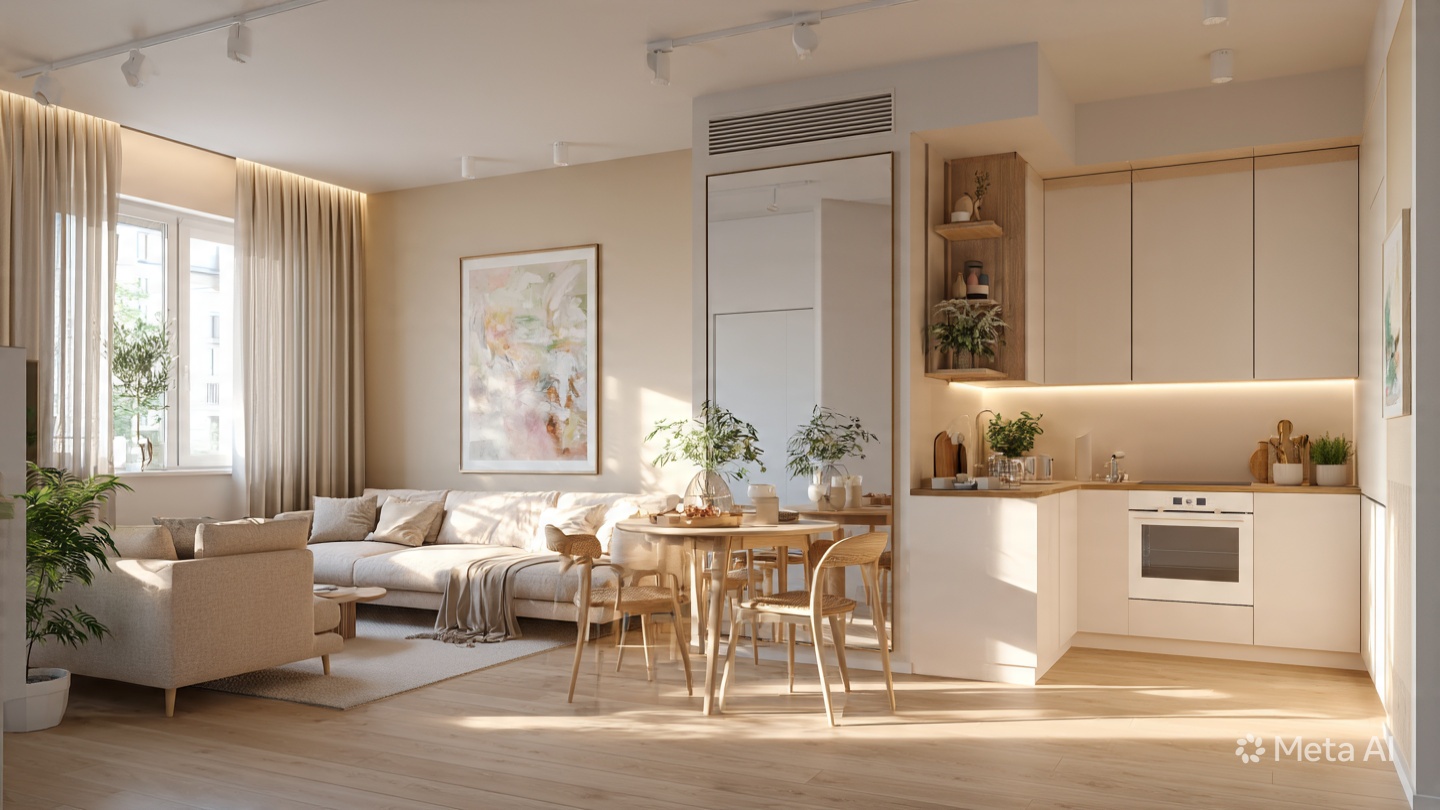
In a small apartment, every decision affects the whole space — furniture scale, lighting, colour palette, storage, and circulation all need to work together. Interior rendering can help homeowners and designers preview the room as a complete concept before renovation or decoration begins. Seeing it all together before anything arrives saves the kind of money that gets spent on returns, repaints, and furniture that technically fits but makes the room feel worse.
Pale Walls: Yes, But Don’t Stop There
Light walls reflect light. Smaller rooms feel bigger when they reflect light. This is real advice, not just something that gets repeated in every interior article.
The part that doesn’t get said: purely white apartments often feel sterile rather than spacious. They need something warmer — a rug with some colour in it, a cushion in a different tone, a plant that’s actually big enough to register. The pale base stays, but something has to stop the room from feeling like it’s waiting to be occupied.
Ceilings are underused. Same colour as the walls, or slightly lighter, and the room gets taller for free.
The Furniture Came From a Different Room
This is the most common problem in small apartments. The owner either brought furniture from somewhere bigger or fell in love with a piece in a showroom without doing the mental work of imagining it in a specific, actual space.
A sofa that seats three comfortably in a large living room takes up more than its share of a small one. Deep shelving units that look great in a large bedroom become a wall in a small one. Wardrobes with wide doors need clearance in front of them that a small bedroom often can’t spare.
Round dining tables are genuinely better in small spaces — no corners pushing into the walking path. Sofas with visible legs instead of solid bases let the floor show underneath, which sounds minor and makes a noticeable difference. Beds with drawers built in solve the storage problem without adding another piece of furniture to solve it.
The Stuff That Doesn’t Need to Be Seen
Visible storage is visual noise. Not always — a good bookshelf can look intentional. But random objects on every surface, baskets you can’t quite identify, boxes that live on the floor: the eye picks all of this up and reads it as disorder.
Built-in wardrobes to ceiling height, a bench at the foot of the bed that opens up, floating shelves instead of freestanding ones, a wall-hung TV setup rather than a unit that lives on the floor — these reduce the amount of visual information competing for attention without removing anything useful from the apartment.
One Mirror, Not Several
A single large mirror in the right spot does a lot of work. It bounces light, it makes the room appear deeper than it is, and in a narrow hallway it removes the feeling of being in a corridor.
Adjacent to a window, or on the wall opposite one, is where it tends to work best — somewhere it picks up daylight and throws it back into the room. The thing that doesn’t work: multiple mirrored surfaces on different walls. The room ends up feeling strange rather than open.
Giving Different Areas a Name
Without some definition, an open-plan apartment becomes one large room that doesn’t feel like any specific room. The sofa and dining table and desk exist in the same undifferentiated space and none of them feel quite right.
A rug under the sofa furniture. A pendant over the dining table — even a simple one, even an inexpensive one. The back of the sofa as a soft dividing line between sitting and working. Curtains that can close off sleeping from everything else.
These don’t make the apartment feel smaller. They make each part feel more like what it’s supposed to be.
The Windows
Natural light in a small apartment: more valuable than most people treat it.
Sheer curtains rather than heavy ones. Nothing tall placed directly in front of a window. Pale floors instead of dark ones, because they reflect light further into the room. A mirror positioned to catch what comes through the window and send it into the corners.
One of these changes tends to matter more than repainting a wall.
Less, but Chosen
One large artwork reads better than three small ones. Plants clustered together look like a decision; the same plants distributed around the apartment look like they ended up there by accident. A rug and a few cushions that have something in common with each other — colour family, texture, something — add warmth without adding clutter.
Small apartments work better when each thing earns its place. Not because of minimalism as an aesthetic, but because there isn’t room for things that don’t.