
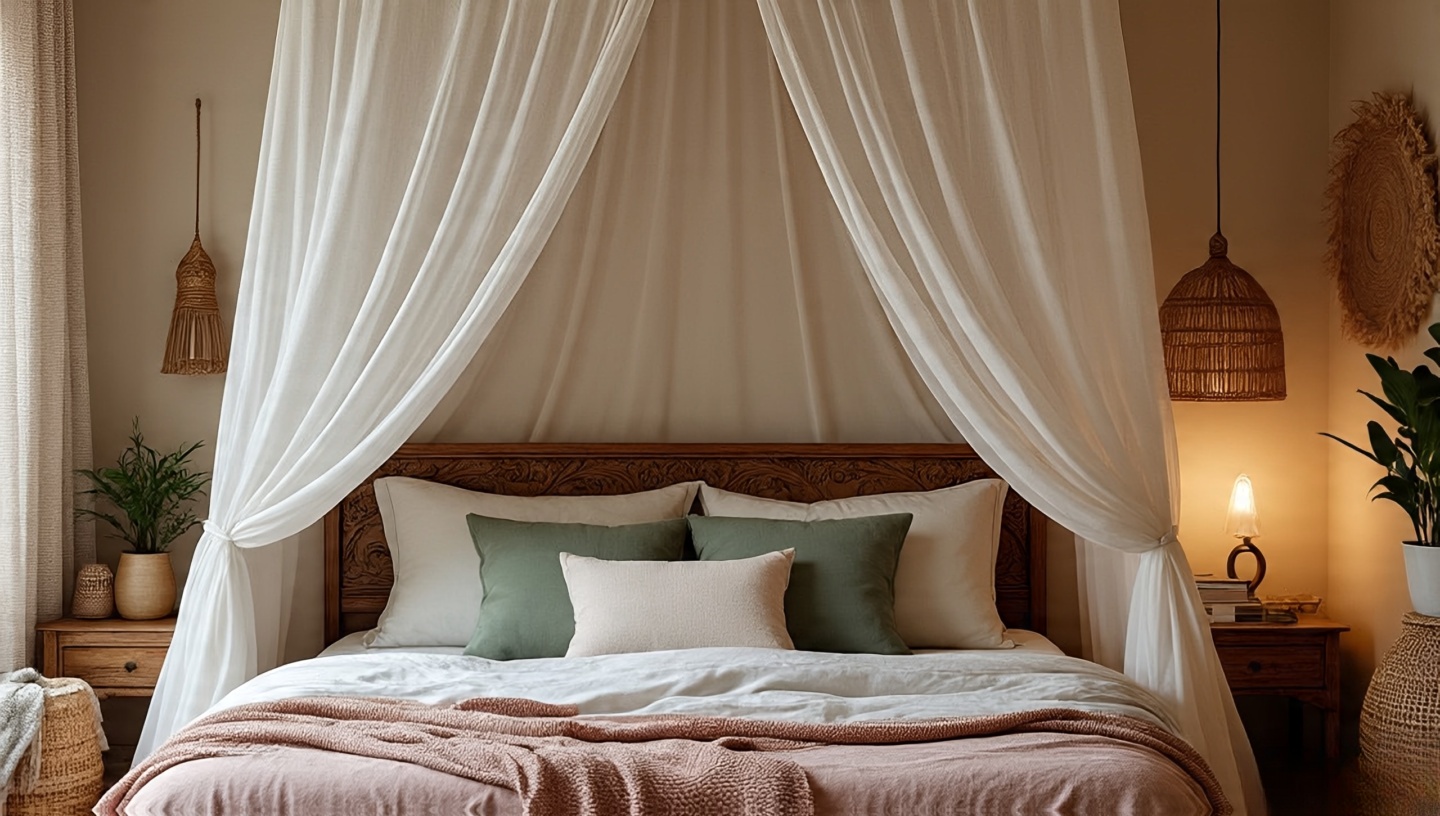
A Bohemian bedroom can use the canopy and headboard as its main visual frame. This guide compares materials, proportions, practical constraints and illustrative arrangements. Check the dimensions and product requirements for the actual room rather than treating a design example as a documented client result.
- Why the bed is always the anchor
- Canopies that feel like a cocoon (without crowding the room)
- Headboards with personality and purpose
- Pairing canopy + headboard without a shouting match
- Real dimensions that actually look good
- Materials & finishes that survive climate and time
- Installation, sequencing, and safety
- Lighting that turns fabric into atmosphere
- Budgets, hidden costs, and where to splurge
- Small rooms vs. large rooms
- Mixing styles without losing Boho soul
- Maintenance rhythms that keep things fresh
- Short answers to real questions
- A quick decision checklist
The bed is the anchor, always
Treat the bed as one clear composition: a canopy provides an upper frame and the headboard gives a background to the pillows. A carved panel can be the principal detail while the rug and side tables remain quieter.
Architect’s note: If you only change one thing, change the element that frames your daily ritual. That’s usually the headboard or the canopy often not the paint color.
Canopies: light-handed drama
A canopy is mood control. It filters light, softens acoustics, and adds a hint of theatrics. The trick is choosing the right structure for your ceiling height and the right fabric weight for your climate.
Structures that work
- Ceiling-mounted rails: Ideal for rooms under 2.5 m. Minimal visual weight; fabric drapes cleanly.
- Four-poster frames: Best with tall ceilings or large rooms. Add soft lights or trailing plants to break the geometry.
- Suspended points (no frame): Hooks at four corners; fabric floats. Great for renters if you use light fabrics and discreet anchors.
Fabric and feel
- Sheer cotton/voile: Airy, washable, works in warm climates.
- Linen: A touch heavier; gorgeous drape and texture; slightly better acoustics.
- Macramé: Texture-forward, dramatic shadows; pair with plain bedding for balance.
- Outdoor-rated cotton blends: In humid zones, these resist mildew and UV better than standard weaves.
Pro tip: For rooms under 10 sqm, keep fabric light and hold it close to the ceiling to avoid a “shrinking tent” effect.
Craving more bedding texture ideas to support your canopy? See this guide to layered Boho bedding mixing kantha, quilts, and linen is half the Boho secret.
Headboards that speak for you
Compare upholstered panels, suitable finished timber and manufactured decorative headboards by support, comfort and care. Choose the form that suits how the bed is used, not just how it photographs.
By lifestyle
- Night readers: Upholstered or cushioned panels save your back; integrate reading lights.
- Hot climates: Rattan/bamboo stay cool to the touch; allow airflow.
- Collectors: Reclaimed wood or carved panels deliver patina and narrative.
Function add-ons
- Shallow niches (10–15 cm) for books and glasses.
- Integrated LED strips with diffusers for a soft halo.
- Hidden cable path + USB-C ports to tame tech clutter.
For headboard-adjacent wall art ideas, skim gallery wall layouts that play nicely with Boho textures. A restrained grid above a simple headboard can be poetry.
Canopy + headboard without competition
If the headboard is ornate (say, hand-carved teak), keep the canopy sheer and quiet. If the canopy is the showpiece (patterned, layered, or macramé), go simple on the headboard. It’s a duet, not a solo battle.
- Teak headboard + voile canopy: Warmth + lightness.
- Macramé canopy + linen headboard: Texture + calm.
- Rattan headboard + linen drape with fairy lights: Earthy + glow.
Dimensions & clearances that actually look right
Rules of thumb
- Headboard height above mattress: 70–90 cm for most rooms; up to 120 cm if ceilings are generous.
- Headboard width: Mattress width + 10–20 cm total, not per side.
- Canopy start: At least 50–60 cm above mattress for airflow and comfort.
- Low ceilings (≤2.5 m): Keep canopy fabric light and mount hardware as high as possible.
Illustrative proportion check: in a room with a 2.4 m ceiling, mock up the canopy line before fixing it. Compare sightlines, usable clearance and the product’s mounting requirements; no single height adjustment guarantees the right result.
Materials & finishes: durability and feel
Wood
Pros: Durable, ages beautifully, adds scent and warmth. Cons: Needs oiling every 6–12 months; can crack if neglected in dry seasons.
Upholstery
Pros: Comfortable, acoustic benefits. Cons: Collects dust; velvet looks luxe but needs frequent care in humid regions. Consider washable slipcovers.
Metal frames
Pros: Strong, slender profile, renter-friendly when freestanding. Cons: Can feel cold; soften with textiles.
Rattan/Bamboo
Pros: Breathable, light visual weight, perfect for tropics. Cons: Avoid direct prolonged moisture; occasional tightening/repair.
Sustainability note: Reclaimed timber and organic fabrics often outlast trendy finishes and carry a history that feels at home in Boho spaces.
Installation, sequencing, and safety
Choose fixings for the actual wall or ceiling, the product and the load. Adhesive hooks should not be assumed suitable for a heavy textile or headboard. Obtain qualified assessment where the support or concealed services are uncertain.
Sequencing
- Confirm bed position and wall centerline first.
- Install headboard or headboard cleat into studs/masonry.
- Add canopy hardware and test tension with gentle pulls.
- Only then style textiles and lights.
Safety basics
- Each canopy hook should be rated to hold at least 10 kg for fabric setups.
- Keep fabric clear of real flames; use LED candles and low-heat LEDs.
- Check fastenings every 6 months.
Lighting: the quiet superpower
Use a separate, suitable lighting arrangement that respects the fitting’s clearance from fabric and the product instructions. Do not tuck an unapproved light source into canopy material to obtain a decorative effect.
Simple lighting recipe
- 2700K warm bulbs near the bed for intimacy.
- One dimmable ambient source; two task sources (left/right).
- Hide cables along canopy seams; use fabric sleeves for neatness.
Budgets, hidden costs, and where to splurge
Quick bands
- $50–200: DIY textile headboard, tension-rod or curtain-rail canopy.
- $300–700: Upholstered panels, carved reclaimed wood, modular canopy frames.
- $1,000+: Custom four-poster, heirloom carved panels, integrated lighting.
Hidden costs: Maintenance adds up wood oils, fabric cleaning, occasional hardware upgrades. Plan a small annual care budget so patina stays patina, not damage.
Where to splurge: The surface you touch daily (headboard for readers; canopy fabric if you crave atmosphere). Save on accessories; invest in anchors and lighting.
Small rooms vs. large rooms
Small (≤10 sqm)
- Ceiling-mounted rails + sheer fabric keep volume light.
- Half-height headboards (70–90 cm above mattress) avoid wall crowding.
- Light bedding colors widen perception.
For an illustrative 3×3 m layout, compare a simple canopy outline with the circulation around the bed before buying hardware. A drawing or removable mock-up can show whether the proposed arrangement crowds the room.
Large rooms or high ceilings
- Use tall headboards or a full frame canopy to “ground” the bed zone.
- If ceilings are high but you dislike towering pieces, go wide: generous headboard width and layered rugs for scale.
- In open lofts, canopy drape acts as a visual room divider.
Mixing styles without losing Boho soul
Boho pairs well with many languages: Scandi calm, Industrial grit, even a touch of hotel luxury. The rule is one leader, one supporter.
- Boho + Scandi: Pale wood, linen canopy, one patterned textile for interest.
- Boho + Industrial: Steel frame bed + soft canopy + warm rugs.
- Boho + Boutique luxury: Brass rods, velvet drape, carved headboard “camping, but fancier.”
If you want broader inspiration beyond canopies and headboards, this roundup of Boho bedrooms is a helpful mood-board to spark combinations.
Maintenance rhythms that keep the magic alive
- Vacuum upholstered surfaces weekly; launder canopy fabric seasonally.
- Oil wood 1–2 times a year, depending on humidity.
- Quarterly: check anchors and re-tension fabric to prevent sagging.
Common mistakes & quick fixes
Too-heavy fabric in small rooms
Fix: Swap to voile/linen; raise mount points by 5–10 cm.
Headboard rattle
Fix: Re-mount into studs, add rubber spacers behind the panel.
Pattern overload
Fix: Stick to the “Rule of Three”: one bold pattern, one subtle, one solid anchor.
Short answers to real questions
How do I attach a canopy without drilling?
Tension rods or adhesive hooks rated 10–15 kg can work with light fabrics. Test gently and check monthly. For anything heavier, use proper anchors.
What headboard height is best if I read in bed?
Target 80–100 cm above the mattress, with either a padded panel or a deep cushion. Integrate sconces at ~1–1.2 m AFF (above finished floor).
What fabrics fight dust and humidity?
Cotton and linen you can launder. Outdoor-rated blends if mildew is a concern. Velvet looks beautiful but needs more care in the tropics.
Can a canopy help with noise?
It won’t replace acoustic engineering, but layered fabric and an upholstered headboard typically reduce echo and make bedrooms feel quieter.
A quick decision checklist
- Measure: Ceiling height, bed width, and wall span. Note outlets and switch locations.
- Choose the lead: Are you prioritizing mood (canopy) or comfort/reading (headboard)?
- Match climate: Breathable fabric for warm zones; denser layers for cold.
- Budget smart: Splurge on the daily-touch element, save on accents.
- Plan care: Seasonal fabric washing, biannual wood oiling, anchor checks.
- Style restraint: If one element is dramatic, let the other whisper.
Finish by checking the usable bed space, access, mounting and care routine. A headboard or canopy should support the room’s everyday use. Start with one well-chosen element and assess it before adding more decorative layers.