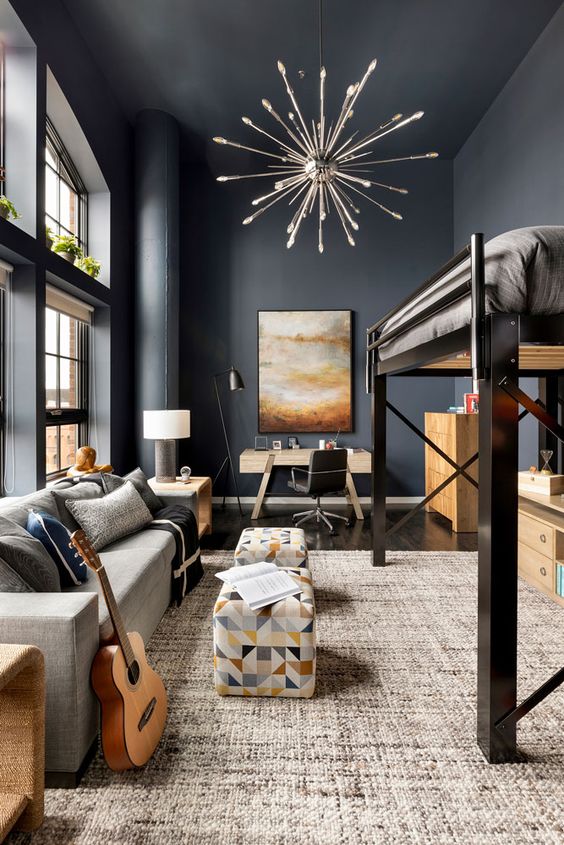
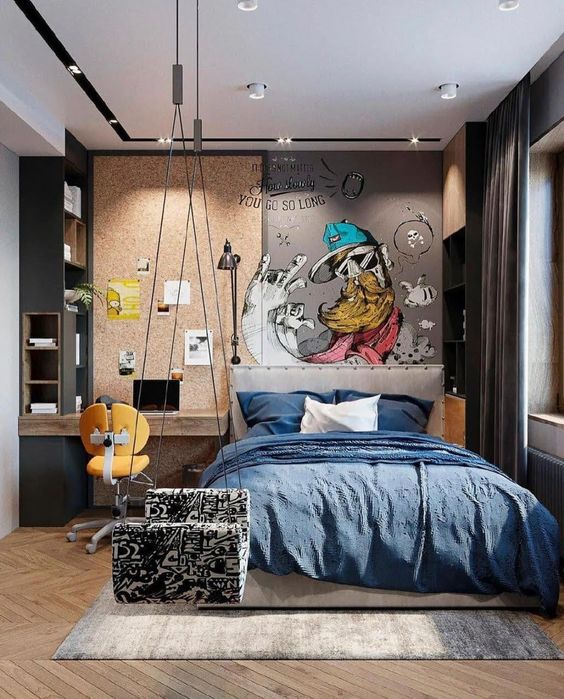
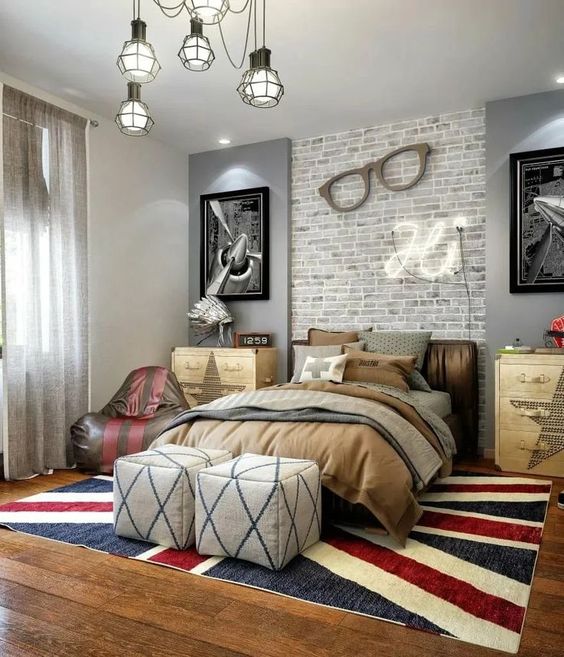
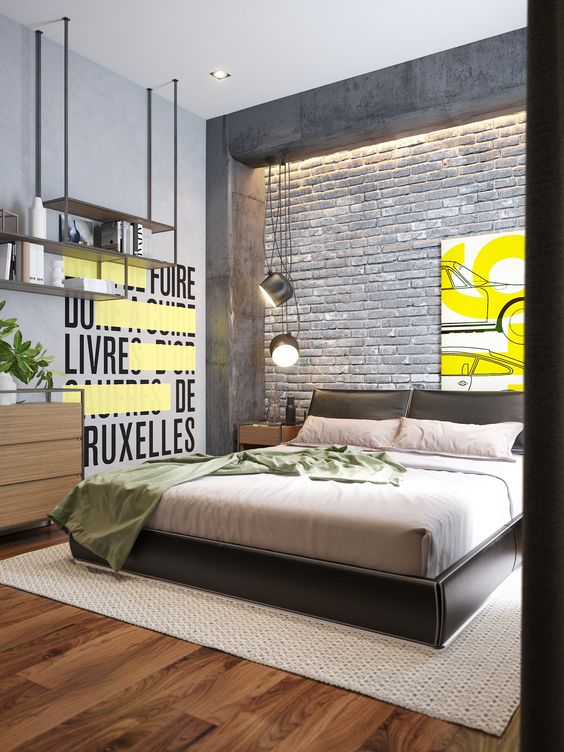
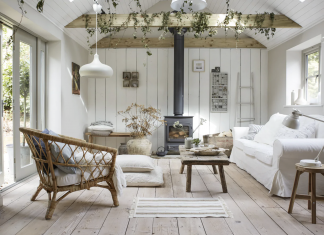
As more people work from home, turning personal spaces into home offices has become more popular. Sometimes, your house is just not suited for a separate workspace for you to thrive in. Creating a studio that will keep you organized and productive is crucial when working from home. How about a space that is right outside your back door? Explore ways to transform a shed into a functional studio.
Shed Studios: Make it Affordable and Customized
Having a shed that is transformed into a workspace has many advantages. It’s a separate work area outside your busy and loud home. We all know it’s hard to concentrate on work if kids have “Bluey” on TV in the background. It’s hard to separate the home and work life while being physically at your house.
There is a way to stay close to home but have a separate personal work studio. And it’s located in your backyard. Shed transformation to a personal work studio is quick and cost-effective. You can customize it to your needs and taste. Creating a creative space in your shed will ensure you are focused and engaged in your work.
Prep Talk: Base Factors for Shed-to-Studio Success
You can go two ways: build a shed or revamp your old one. If you are revamping, assess the shed’s structural integrity. Check your shed for weaknesses in the construction – roof leakages, wood damage, flooring, and wall defects.
Here’s a quick list to go through:
Roof inspection for any signs of water damage or damaged roofing material.
Wood examination for rot, decay, or termite damage.
Flooring evaluation for any signs of water damage.
Wall inspection for cracks and holes in the walls.
Foundation for stability and any signs of settling.
Prepare your shed wisely, ensuring a solid foundation for a successful and inspiring studio transformation.
Metal Sheds: Durable, Stylish, and Easy to Customize
If you don’t have a shed, it’s worth exploring metal sheds as a prime option. Metal sheds are durable and offer robust structural support, weather resistance, and longevity. They are easy to maintain and have many set options of sizes, styles, and colors. Metal sheds provide a lasting solution and a sleek and customizable aesthetic.
Keeping in mind your needs for space and storage, you can transform them into actual construction.
Comfort Matters: Insulate and Control Climate
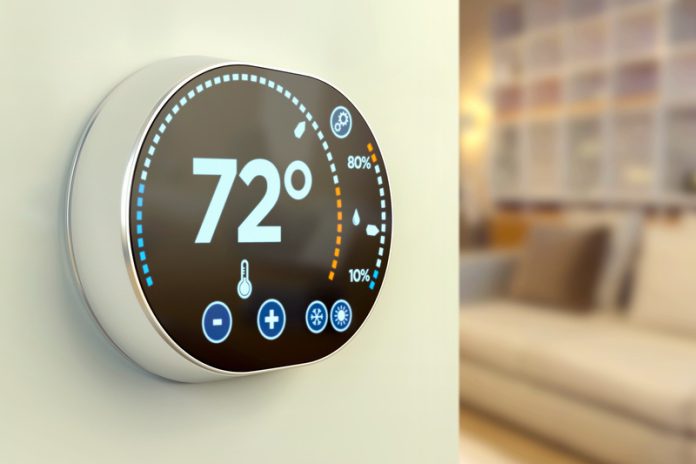
Consider proper insulation and climate control for a comfortable working environment in your studio. This is a significant factor in ensuring your basic temperature needs are met. Climate control tools, such as ventilation and heating, will keep you working comfortably all year round.
Personalize workspace to increase productivity.
When your shed-studio shed is ready, make it perfect for you and your work. Personalized space may seem insignificant, but it boosts productivity. You can look at your studio from 2 perspectives – functional and creative. Both are equally important to incorporate into building your workspace.
Basics of Building a Functional Environment for Success
Ensure your work days are focused on something other than the lousy lighting or uncomfortable computer chair. If the basic requirements of the working environment are not met, it affects the long term.
Start with ergonomic furniture that reduces stress on the body from working long hours.
Plan suitable lighting – aim for around 50-75 lumens per square foot. Tailor lighting tone for your needs from warmer to lighter – it will have an impact on productivity.
Look for adjustable height tables and appropriate chairs with the proper support for your neck and back.
Implement organization spaces to keep the studio clutter-free. Plan for shelves, boxes, and storage spaces to ensure clean space.
Remember the creative elements in the studio for relaxing in breaks. Incorporate a chill zone, get some artwork or inspiring decor, and add color.
Customizing Your Studio for Optimal Functionality
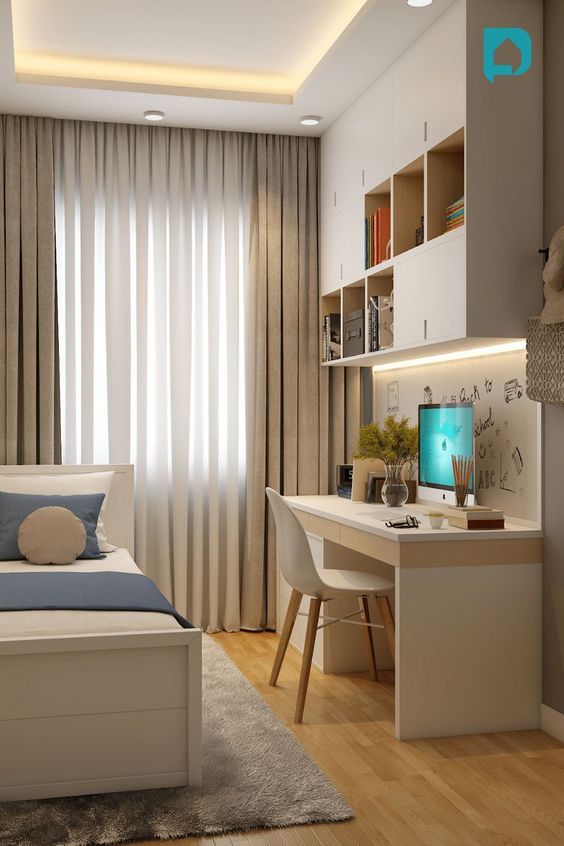
Look for design elements and furniture that suit the best for daily tasks. For example, an artist’s studio may need desks with storage spaces. Areas for painting, storage shelving, and an extra thought-out ventilation system will be required.
If working mainly on a desktop, you must look for an ergonomic chair and desk with quality lighting.
A photographer might need designated camera equipment storage space and a product photography set.
The possibilities are endless; know your needs and create a personalized space for them.
The shed studio for healthy work-life balance
Creating a functional studio for yourself is the best investment in the long term. Working will be a breeze if you have a comfortable, functional, and creative space. Remember to assess your needs and prioritize a durable option for the studio shed you create.
The at-home working model offers an opportunity for the healthy work-life balance we all strive for. Transforming the old shed can be a fun family creative project for the benefit of having you more available. Designing a new metal shed for the best functional working space will add value to your daily work.
roohome.com– No matter how small the bedroom, this room should feel comfortable. As a place to rest and unwind, comfort is an important point that must be considered carefully. Not all decorations, concepts, or designs will be suitable for the small bedroom. Therefore, you have to find decorations, concepts, and designs that fit your bedroom, regardless of your characteristics. One effective way to make a small bedroom feel comfortable is to make it feel more spacious. Through this article, we will help you in having your own cozy small bedroom. So, here are 22 Tips to Make The Small Bedroom Feel More Spacious you can follow!
1. Choose Light Colors
Cc: Pinterest
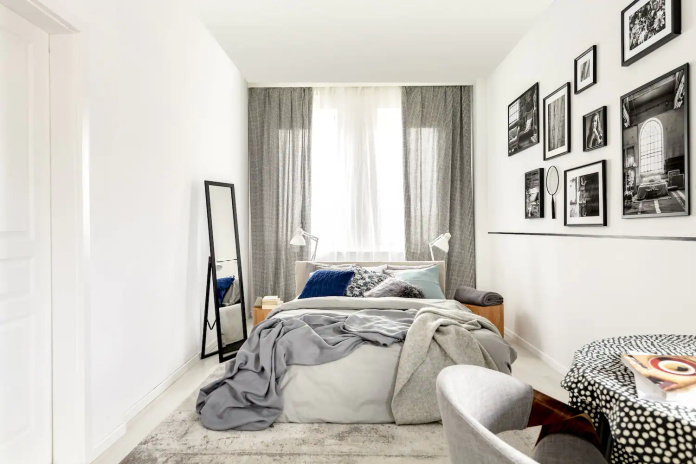
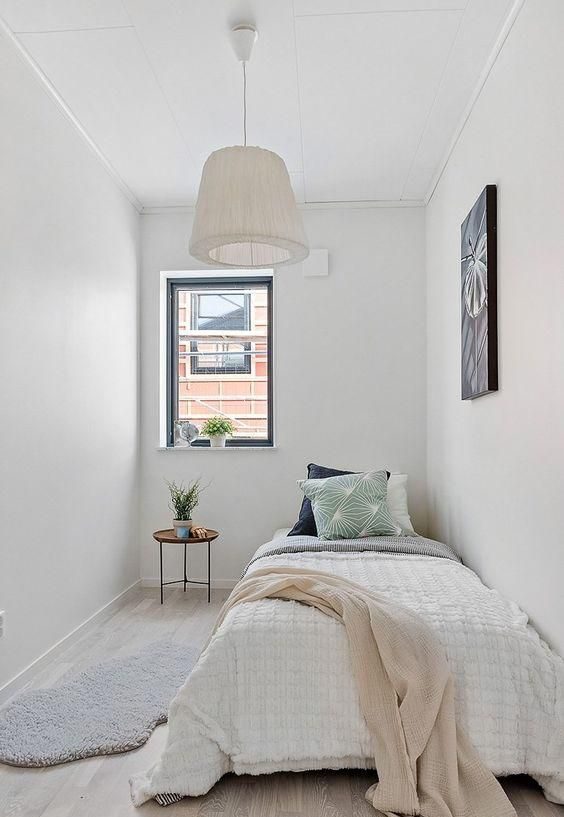
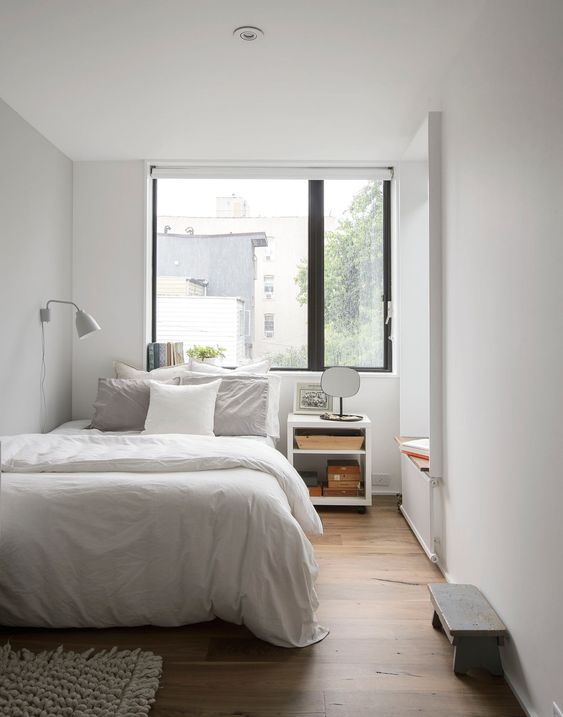
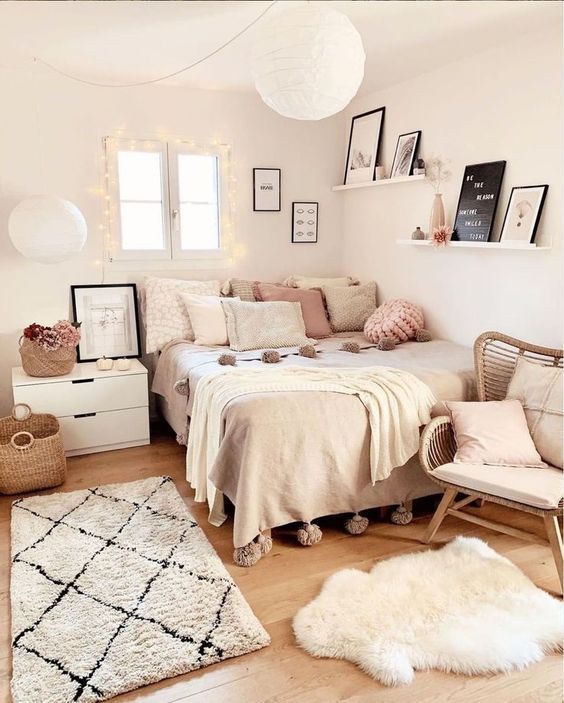
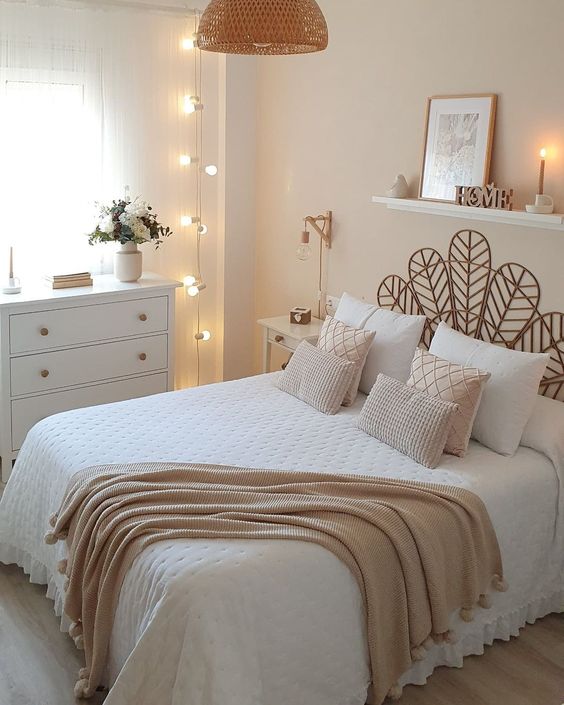
There are several important aspects that influence the comfort and beauty of a room such as color, decoration, lighting, and so on. And, the first of 22 Tips to Make The Small Bedroom Feel More Spacious is to choose a light color. We recommend choosing neutral colors. White is an alternative color that you can make as the first option for your small bedroom.
Making white the main color in the room can eliminate dark corners there so the room will feel more spacious. Not only that, the small room also becomes brighter so you won’t feel cramped and stuffy in this small room.
2. Coordinate The Flow of Color
Cc: Pinterest
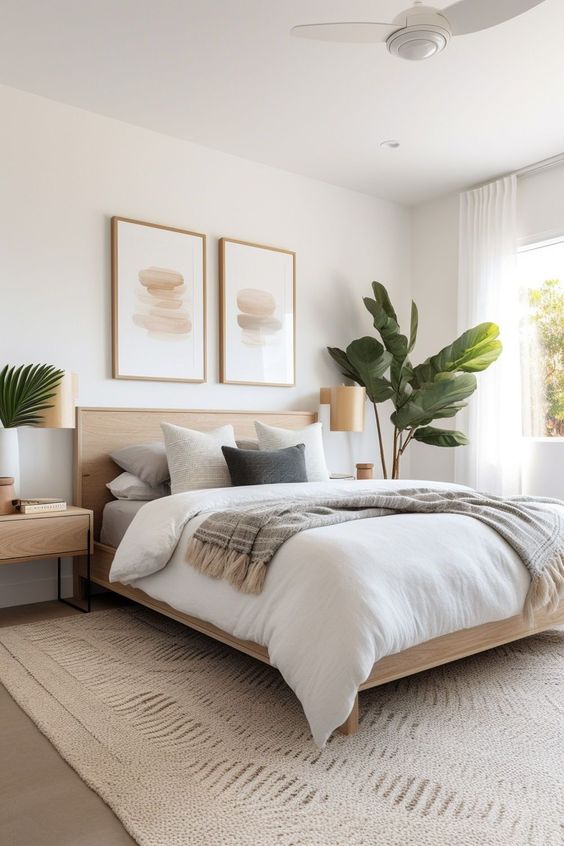
Refine the appearance of the room for a simpler, neater, and cleaner impression. That way, the small bedroom does not look full and messy. You can coordinate the flow of color. Present one color as an accent with different shades. For the walls, choose colors with lighter tones to maintain a bright appearance in the small bedroom. And, choose a darker color tone for small spots. It would be better to present it in the main spot in the bedroom, which is the bed. There is no need to apply it predominantly like all over the bedding, just apply it to the pillows and blankets and leave the bedsheets white.
3. Make The Ceiling Darker
Cc: Pinterest
The eye’s attention will be focused on a different spot. So, by making the ceiling darker than the walls it will attract your eyes. With this, you will look towards the high ceiling. This is very helpful in giving the illusion of walls in a small room so that the room will feel more spacious. This is the next of 22 Tips to Make The Small Bedroom Feel More Spacious you can follow.
If you do not want to paint it a dark color, you can play with natural materials such as wood. Whitewashed walls and wooden ceilings are the perfect combination that can bring a natural feel full of calm and freshness into the bedroom. That way, the room will also feel more comfortable.
4. Use Double-Functional Furniture
Cc: Pinterest
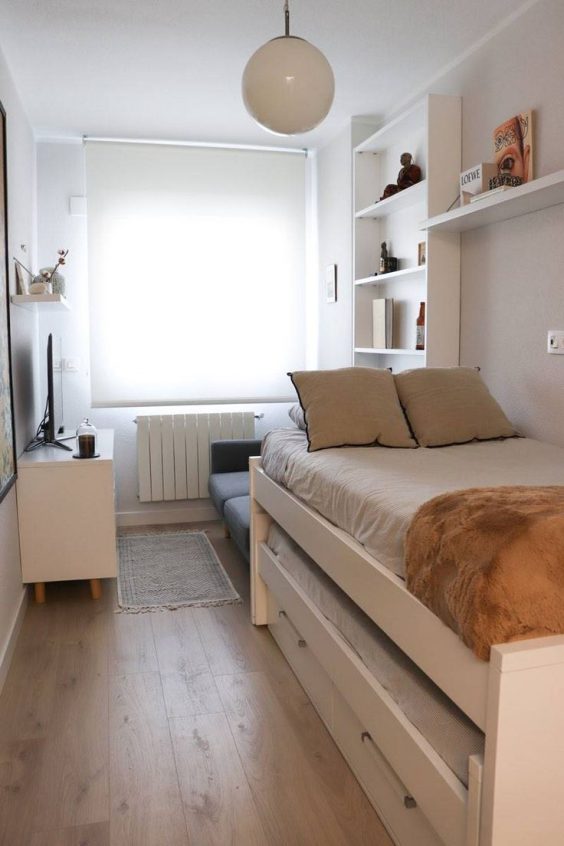
Limited space in the small bedroom requires you to really think creatively and smartly in choosing furniture. Instead of using different furniture in a small bedroom, it would be better to use double-functional furniture. It becomes the next of 22 Tips to Make The Small Bedroom Feel More Spacious.
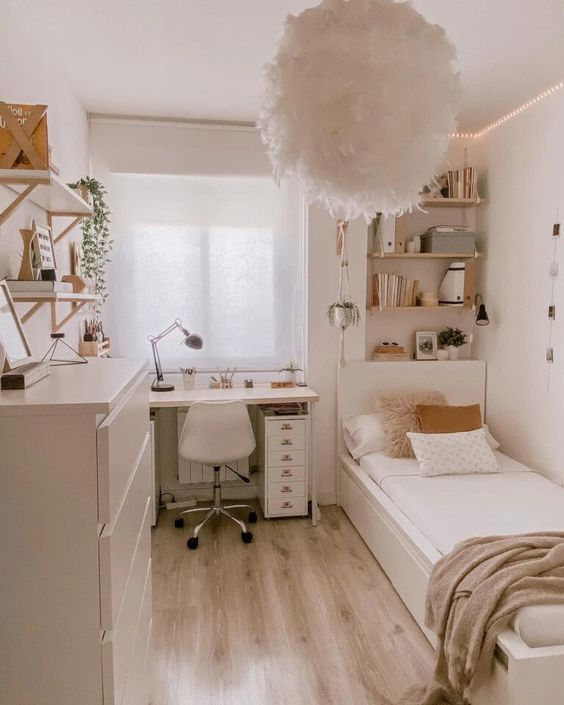
Choose a bed that can also be used as storage. Currently, there are many frames with the bottom area being a drawer that you can use to store clothes. That way, cupboards are no longer needed in the bedroom. And, you can use the other space as a cozy spot or comfortable workspace area.
5. Remove The Bed Frame
Cc: Pinterest
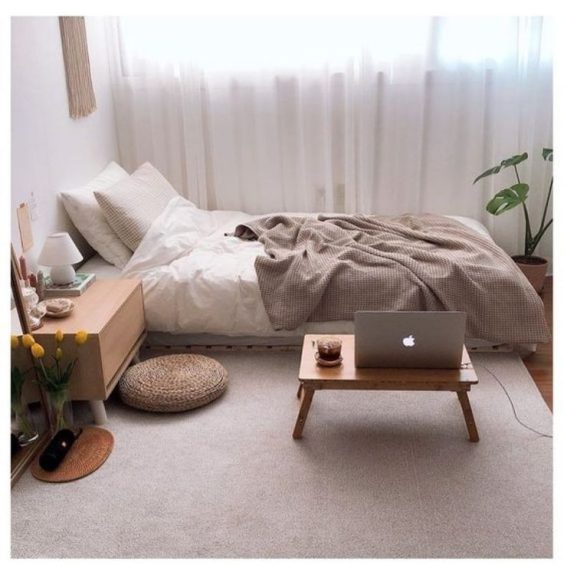
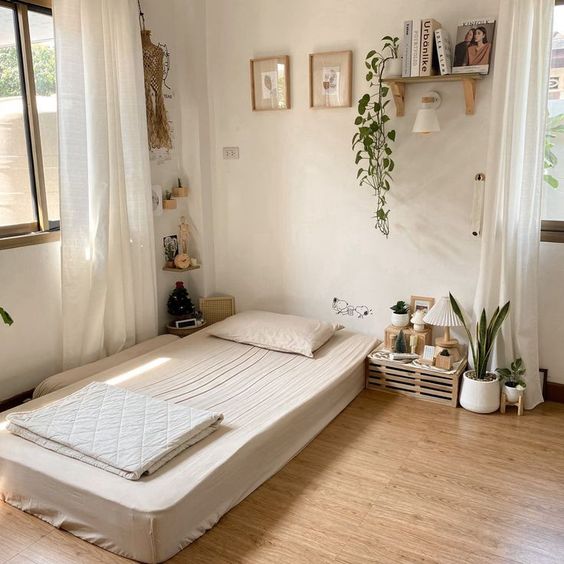
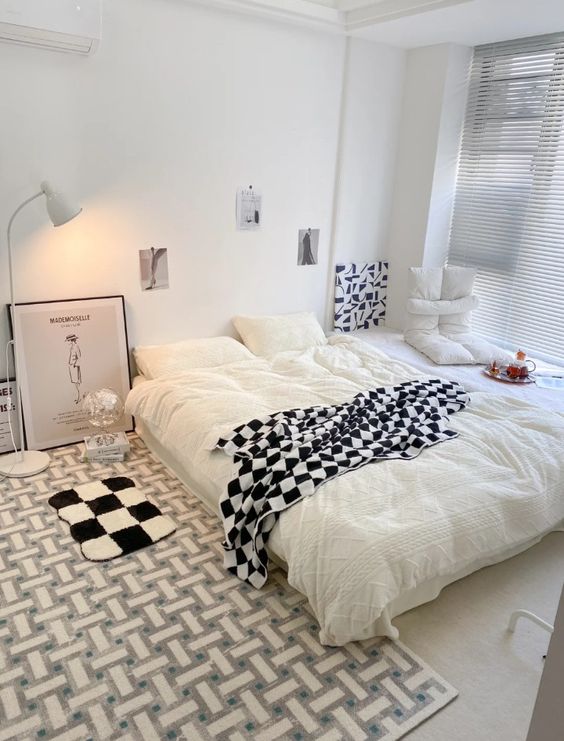
The next of 22 Tips to Make The Small Bedroom Feel More Spacious is to remove the bedframe. Or, this can also be called bed on the floor style. This tip can give a tall effect on the walls of the room. That way, the small bedroom will feel more spacious.
Some people also think that the bed on the floor style feels more comfortable compared to using a bed frame. This gives a relaxed feel to the room. However, to make it feel more comfortable, use a rug or carpet on the bed. Also, use screened bedding which can brighten your sleeping space.
6. Use Bunkbed
Cc: Pinterest
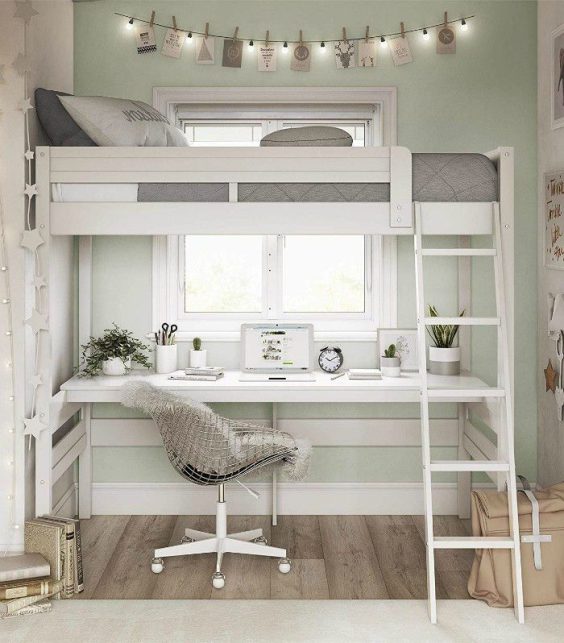
Another easy way to make the small bedroom feel more spacious is to use a bunk bed. Make the bunkbed more creative by making it have two functions, which are a bed and a comfortable place to work. The top area of the bunkbed is a place for you to sleep. And, the bottom is a place to work or study.
Choosing a white bunk will help brighten the appearance of the room and make the room more spacious. Besides that, it also gives a natural look into the small bedroom.
7. Use Low-Profile Furniture
Cc: Pinterest
When filling or decorating your bedroom, make sure you choose the right furniture. You can fill the room with the furniture you really need. This will really help in saving the space in the small bedroom. However, there is another aspect that you also have to pay attention to, namely the design of the furniture itself. For the small bedroom, it would be better to use low-profile furniture. This method can make the walls in the room look higher so that this small room can feel more spacious.
Do it consistently for maximum results. If you use a low-profile bedframe, then also use a low-profile bedside table. And, so on, just follow.
8. Transparent Furniture is A Good Way
Cc: Pinterest
The transparent furniture looks present but is not present. Because of its transparent appearance, the furniture does not disturb the space in the room at all. You can still see the walls in the room from anywhere. That way, a small room will not feel cramped, and quite the opposite.
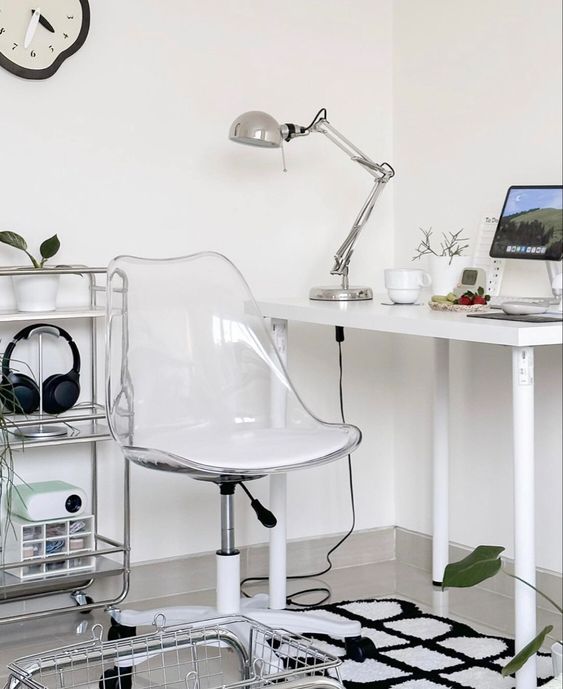
Transparent furniture is an easy way to make a small bedroom feel more spacious. For the workspace, you can use a transparent chair. It doesn’t matter if it’s only transparent at the top of the bench while the bottom still looks like iron, black and white because the eye only looks at the room horizontally.
9. Built-in Shelving
Cc: Pinterest
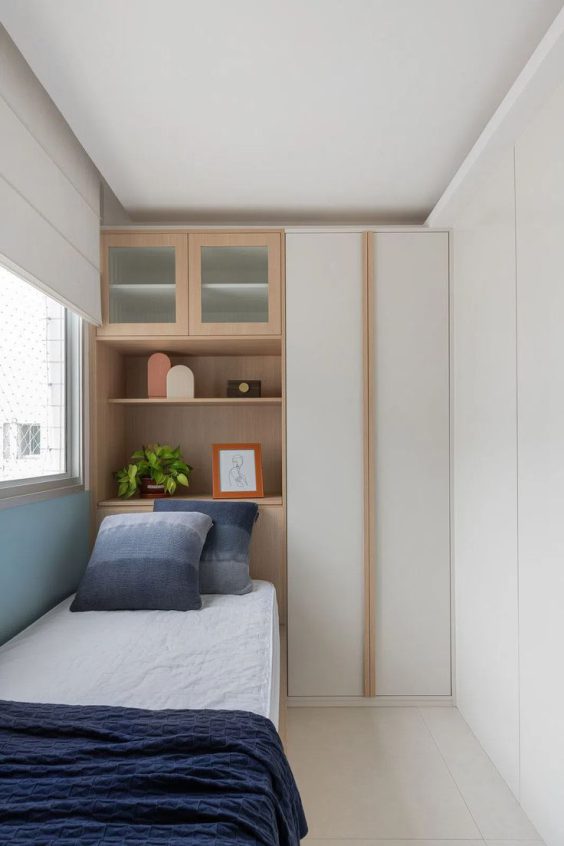
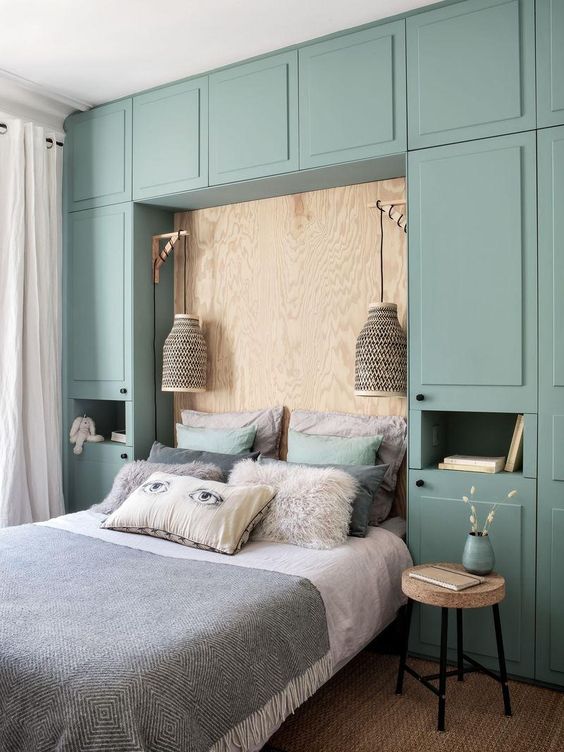
The built-shelves in the small bedroom are the perfect storage or decorative area. Even though the built-in shelves are a storage place, they look like walls so they do not have a cramped or full effect compared to using shelves or installing floating wall shelves.
Create the built-in shelves near the bed. You can make it match the wall by painting it with the same color. However, if you want, make it look attractive, and present different colors. Pastel colors can be an option to give a soft impression to your small bedroom. And, the same color is also present on the pillow on the bed.
10. Avoid The Middle Area
Cc: Pinterest
In making the small bedroom feel more spacious, we have to be smart in utilizing the existing space. By using the same furniture, we must be able to provide more space in the room. Make the empty space wider by not placing large furniture in the middle of the room. So, it is better to place the bed at an angle and touch up to the bedroom wall. That way, there will be a larger empty space that can make you feel more spacious in your small bedroom.
11. Present Large Mirror in The Bedroom
Cc: Pinterest
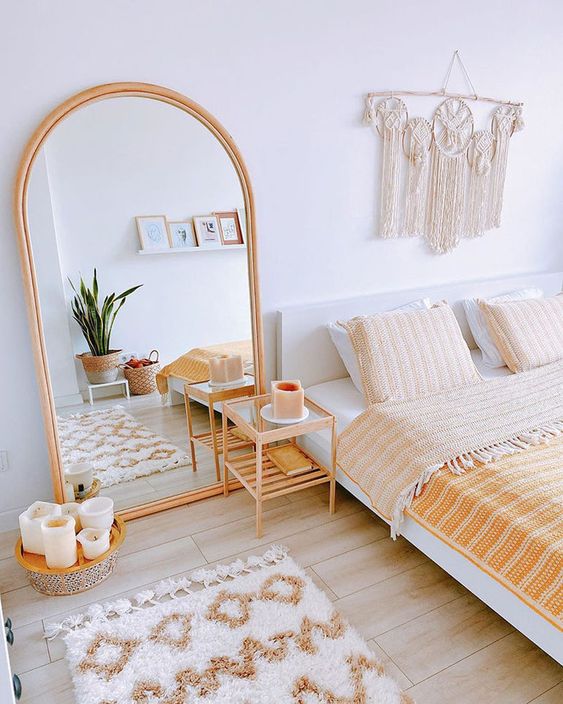
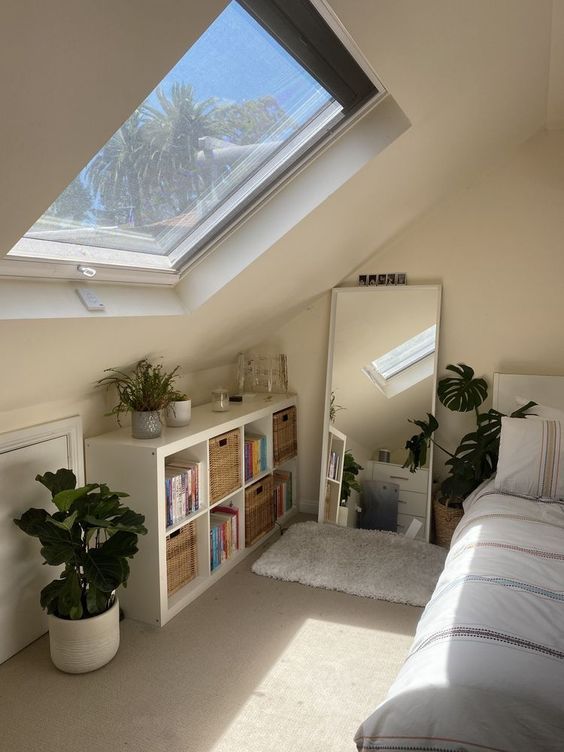
Many mirror designs currently available add their function as displays to add aesthetic value and beauty to the room. However, the function of the mirror does not stop here. For small bedrooms, mirrors can provide a wider effect which can make it comfortable as a room to relax.
Standing mirrors are the most appropriate type of mirror for the small bedroom. This kind of mirror has a larger size which can reflect a wider room. Leaning it against the wall seems to remove a barrier in the room. And this is what makes the room feel more spacious.
12. Minimize The Quantity of Colors
Cc: Pinterest
One way to make a small room feel comfortable is by not making it full. That way, this small room can avoid the very annoying cramped and stuffy feeling. Therefore, minimizing the number of colors is a very appropriate trick. This is the next of 22 Tips to Make The Small Bedroom Feel More Spacious you can follow.
Choosing just one color for the small bedroom can really make it feel calm. However, this is very risky because it can give a stiff and unattractive effect on the room. Therefore, just choose two or three colors. Use colors that fall into neutral colors. Or, you can choose a pastel color for a more attractive appearance.
13. Take Advantages of Walls
Cc: Pinterest
Try to save space in the small bedroom by using only furniture that is needed. And, avoid using large furniture such as shelves. So, if you want to have storage in the bedroom, just rely on the walls in the room. You can use the wall as a place to store some of your things such as books, photos, storage boxes, and so on. Besides that, you can also put up some interesting displays such as pictures and small plants.
14. Organizing Your Bedroom Well
Cc: Pinterest
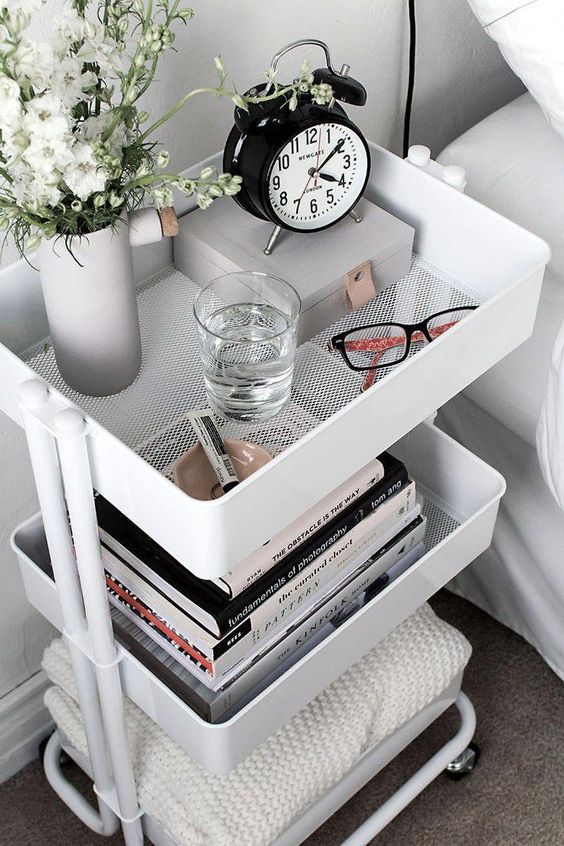
Bedrooms often have several items ranging from books, blankets, alarms, and so on. If it is not organized well, the small bedroom will look full, messy, and dirty, which is not very good for the beauty and comfort of the room itself. However, using large shelves to store all these items will really take up the available space and make the room cramped. With this, try to use furniture that has the same function but can also be used as storage, such as a 3-tier rolling storage cart as the bedside table.
15. Create More Space in The Bedroom
Cc: Pinterest
Creating more space in a small bedroom is the next of 22 Tips to Make The Small Bedroom Feel More Spacious you can follow. Here, you only need to focus on the main item which is the bed. The bedroom cannot be called a bedroom if there is no bed there. So, actually just using the only bed for the bedroom is enough. No need for a wardrobe, desk, and so on.
If you think it will look stiff and boring, then play on layered bedding. Use bedding in different colors for a more colorful impression. Next to the bed, you can fill it with wicker baskets for the pillows. Also, decorate the floor with rugs so that it doesn’t look empty and hollow.
16. Add More Lamps
Cc: Pinterest
Lighting is an important aspect of a room. Small rooms need more light to make them look bright so the room is not cramped and stuffy. Not only that, excess lighting can also erase dark corners. That way, the small bedroom will feel more spacious.
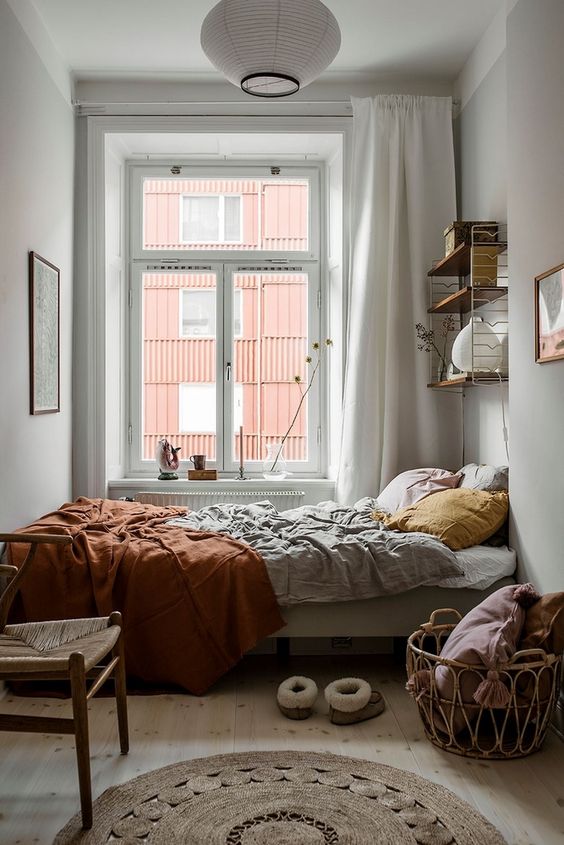
Natural lighting is the most important for the bedroom. Make this the main light in the room. However, for the white bedroom, excessive natural lighting can have a disturbing glare effect. So, make sure you filter the light by using white sheer curtains. Provide excess lighting by using additional lights such as string lights. This is the next of 22 Tips to Make The Small Bedroom Feel More Spacious that you can try.
17. One Display is Much Better
Cc: Pinterest
For the small bedroom, it would be better to play with textures to beautify the room. However, if you still want to fill the wall with a display, use one display but in a larger size. So, even if it’s just one, the display will stand out on the bedroom wall.
The spot you choose for the display is also very determining. Because there is only one, hang the display on the main wall, that is the wall at the back of the bed. Adjust the display to the width of the headboard. Place it in the middle.
18. Use High Drapes and Let It Hit The Floor
Cc: Pinterest
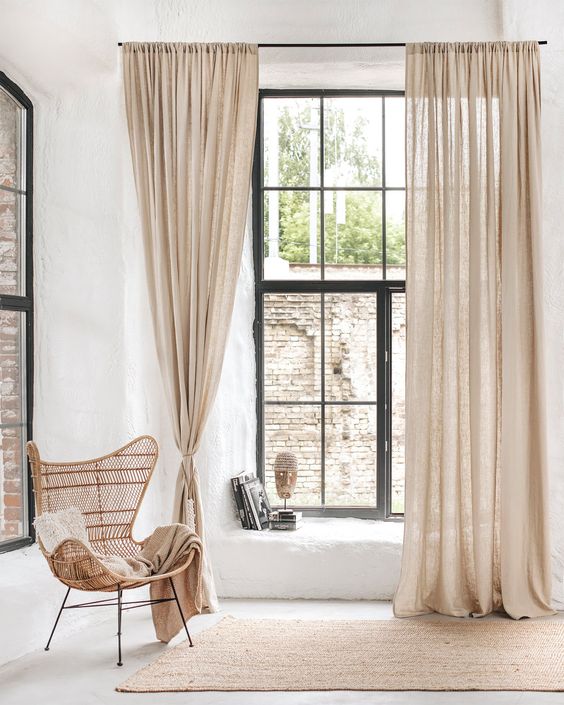
The next of 22 Tips to Make The Small Bedroom Feel More Spacious is to use high drapes and let them hit the floor. This is a trick to create the illusion of height on the walls of a room. On the ceiling, leave an empty space as wide as the window in the room. That way, you can hang the curtain even higher. So even though there is a ceiling there, the walls seem to exceed the ceiling.
19. A Sheer Curtain is Better Than a Thick Curtain
Cc: Pinterest
Windows are a way for light to enter the room. And, for small rooms, maximum natural light is needed to eliminate the annoying cramped and stuffy feeling. Therefore, avoid closing windows with curtains. However, if you want to maintain your privacy at home, you can use sheer curtains.
Sheer curtains can also be used for the white small bedroom shades. The dominant white color when illuminated with maximum natural light will create a glare effect in the eyes which is very disturbing. So sheer curtains are needed to filter the light entering the room.
20. Keep Your Room Simple
Cc: Pinterest
The next of 22 Tips to Make The Small Bedroom Feel More Spacious is to keep the room simple. Just fill the room with beds so that there is more free space available in the room. However, this one way is very risky because it can make the room seem stiff, empty, and boring. Therefore, it needs some decoration.
You can still use decorations but make sure to keep it simple. Small indoor plants are the most appropriate decoration for the room. You can place the plants vertically starting from the floor, on the bedside table, and on floating wall shelves.
21. Let The Natural Lighting Enters Freely
Cc: Pinterest
Make natural light enter the room freely by making curtains in the morning. This will really help in making the room bright and removing shadows and dark corners. That way, the small bedroom will feel more spacious.
No need to worry that natural lighting will make the white small bedroom shades seem dazzlingly bright. Everything can be overcome by presenting black and also using more dominant wood materials. Also fill the floor area with a large carpet.
22. Decorate The Floor with Rug
Cc: Pinterest
The last of 22 Tips to Make The Small Bedroom Feel More Spacious is to decorate the floor with a rug. If the drapes create the illusion of height on the walls, the rug creates the illusion of width in the room. However, the size of the rug itself is very determining. Try not to use a rug that is too small or too large to cover the entire surface of the floor. The color of the rug must also be natural to maintain the concept and calm of the bedroom.
Final Words
Creating a comfortable small bedroom is actually not difficult if you know the tips and tricks. The right decoration will give a spacious effect to a small bedroom and make it comfortable. One way is to make white the main color which can eliminate dark corners in the room. For maximum results, apply the 22 points above to your small bedroom. So, good luck and good luck!
With the winter season already upon us, professional house painters are confronted by a unique set of challenges that wield considerable influence over their work. One of the most notable of these challenges revolves around the substantial impact that cold temperatures can exert on paint. As mercury drops, the behaviour of paint, especially concerning its drying and curing times, takes on heightened significance. Therefore, it becomes imperative for house painters to possess a comprehensive understanding of these effects to ensure the achievement of a flawless and long-lasting finish. Within the confines of this blog post, we will embark on a journey to explore the multifaceted ways in which winter’s cold grip shapes the course of paint while examining its direct implications for diligent house painters. Furthermore, we will provide a wealth of invaluable tips and insights to help everyone successfully navigate the intricate challenges presented by the winter season.
Understanding the Impact of Low Temperatures on Paint
Slower Drying Times
One of the most notable effects of cold weather on paint is slower drying times. When the temperature drops, the solvents in the paint take longer to evaporate, causing the paint to remain wet for an extended period. This can lead to several issues for house painters, such as an increased risk of dust and debris sticking to the wet paint surface. Additionally, the prolonged drying time can hinder productivity and cause delays in completing projects.
House painters should use paints specifically formulated for cold weather applications to counter this. These paints contain additives that help accelerate drying times in lower temperatures. Using a low-temperature paint can significantly improve efficiency and ensure a smooth finish even during the winter months.
Reduced Curing Speed
Curing is the process by which paint chemically bonds and hardens over time. In cold weather, curing times can be significantly delayed, leading to a less durable and less resilient finish. The slow curing process can also make the paint more susceptible to damage, such as chipping and cracking, particularly in high-traffic areas. To address this issue, house painters should carefully consider the manufacturer’s recommendations for optimal temperature ranges during the curing process. In some cases, it may be necessary to use additional curing agents or apply a second coat of paint to ensure adequate protection during the winter season.
Poor Adhesion
Low temperatures can also affect the adhesion of paint to the surface. Cold weather can cause the paint to contract, making it less likely to bond effectively with the underlying substrate. This can lead to issues such as peeling, flaking, and blistering, which can compromise the appearance and longevity of the paint job. House painters should properly prepare the surface by cleaning and priming it before applying paint to enhance adhesion in cold weather. High-quality primers and adhesion promoters can help ensure the paint adheres securely, even in suboptimal temperature conditions.
Tips for House Painters Working in Winter
Check the Weather Forecast
Before starting a painting project in the winter, it’s essential to monitor the weather forecast closely. Try to schedule outdoor painting jobs during periods of milder temperatures and avoid days with freezing temperatures or heavy precipitation. Planning ahead can help minimize the negative effects of cold weather on paint.
Store Paint Properly
House painters should store paint in a temperature-controlled environment to prevent it from freezing or becoming too cold. Extreme temperature fluctuations can degrade the quality of the paint, leading to problems during application and drying. Always store paint in a dry, insulated space to maintain its integrity.
Use Heaters and Insulation
When working on interior projects during the winter, consider using portable heaters to maintain a comfortable working temperature. Proper insulation in the workspace can help speed up the drying and curing process by providing a more stable and warmer environment for the paint.
Warm Up Paint Before Application
Cold paint can be challenging to work with, as it may not flow smoothly or cover evenly. To combat this issue, house painters can warm up the paint before use by placing it in a warm room or using a paint warmer. This can help improve the paint’s consistency and ensure a more uniform application.
Follow Manufacturer Recommendations
Always adhere to the manufacturer’s recommendations for your specific paint product. These guidelines will provide valuable information about the optimal temperature range for application, drying, and curing. Deviating from these recommendations will likely result in subpar results.
Conclusion
Winter bestows upon house painters a distinctive set of challenges, where the frigid temperatures profoundly influence the behaviour of the paints they employ. This manifests as the extended drying periods, a decelerated curing process, and the perilous threat of poor adhesion, all conspiring to jeopardize the calibre and longevity of every brush stroke. However, armed with a profound comprehension of these nuances and the strategic guidance provided above, house painters can confidently navigate the icy waters of winter, emerging with results that exude professionalism and excellence. As the winter season unfolds its frosty embrace, make it your mission to prioritize the deployment of cold-weather paint products and adhere meticulously to preparation techniques. In doing so, you’ll ensure the creation of visually captivating masterpieces and enduring works of art that stand the test of time.
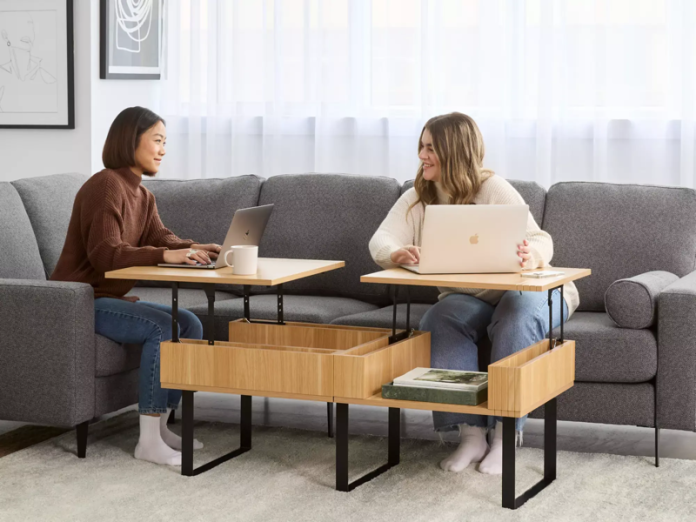
It might be hard to believe that a simple coffee table can make such a big change in someone’s living space. However, in this age of ever-evolving trends and technologies, even a coffee table can inspire innovation! Where versatility meets style, the lift top coffee table is exactly what you need if you are in need of a modern look and feel in your home. The design incorporates a top that you can raise and lower at your desired height, making it the perfect table for any living room activity. Additionally, it features enough storage space to keep your home tidy and organized. With such a convenient and practical design, who wouldn’t love a lift top coffee table?
Versatility and Functionality:
The stand-out feature of the lift top coffee table is its multifunctional capabilities. With its adjustable top, it can be used as a desk for your laptop, a casual dining spot, a surface for board games and puzzles, a craft table and more. This adaptability makes it ideal for people living busy and active lives, as it seamlessly integrates into dynamic lifestyles. Whether you’re hosting movie nights, or playing board games with the kids, you will always have a table to rely on.
Storage Space:
Whether your space is big or small, storage is always a problem for homeowners to deal with. Luckily, the lift top coffee table accommodates even the messiest living rooms. Thanks to its compartments, clutter can easily be organized and stored out of sight. This is especially useful for those who work or study from home, as you can easily store your laptop and notebooks away. And for those who can never find the remote, you can now rely on your stylish new coffee table for suitable storage. Say goodbye to the chaos of magazines, remote controls and laptops piling up in your living room.
Space-saving Solution:
In addition to its wonderful storage solutions, the lift top coffee table also incorporates a perfect space-saving design. In compact living environments, homeowners must pack as much functionality into as few square feet as possible. This coffee table represents just that, turning a mere living room into a multi-purpose space for all to enjoy. So you want to maximize the utility of your space, all you need is one coffee table. It’s just that easy!
Style and Design:
A popular concern when shopping for furniture is its style and aesthetic. This concern is what inspired the look of the lift top coffee table, which incorporates a modern minimalist design. The quality and precision put into its manufacturing ensures a clean and chic look that can complete any living room. If you want to add a touch of sophistication to your home, look no further than the lift top coffee table.
Convenience and Comfort:
Picture this: you are enjoying a quiet morning on your sofa, sipping your coffee and watching your favorite morning show. You decide to get an early start to your workday, and all you need to do is lift your table top to your desired height, lock it in place and take out your laptop from the compartment. Now, your living room has become your office!
If you live a busy life, and understand the clutter of modern living, you will understand why so many have opted for a lift top coffee table. With unmatched functionality, convenient storage, and a timeless look, this piece of furniture is the pinnacle of modern living. At Cozey, we offer a curated selection of lift top coffee tables that seamlessly blend style with functionality. Explore our collection here to discover the perfect addition to your modern living space.
roohome.com– Decoration is the key to a room looking filled and beautiful. That way, the room does not seem empty. Even minimalist designs still have displays that have the same concept to sweeten and eliminate the stiff impression of the room. There are plenty of room decorations that you can choose to beautify your favorite room. Starting from exorbitant prices to very affordable ones, from limited editions to those that can be found in any store, and many more. However, among the many decorations, using simple decorations is much more tempting. Here, we have provided 20 Simple Decorations That Will Enhance The Home Interior
1. Freshness in The Corner of The Room
Cc: Pinterest
The corner of the room near the window is the right spot for you to bring freshness. The large plants there will fill the corners of the room well. And, the spot that gets sunlight will greatly influence the freshness of the plant itself. As we know, plants are living creatures that need sunlight to photosynthesise. And, by placing it there, the plant can still survive. The green color of the plants will look fresh and help freshen up your room. This is the first of 20 Simple Decorations That Will Enhance The Home Interior that you can follow and apply.
2. Pile Up Books on The Floor
Cc: Pinterest
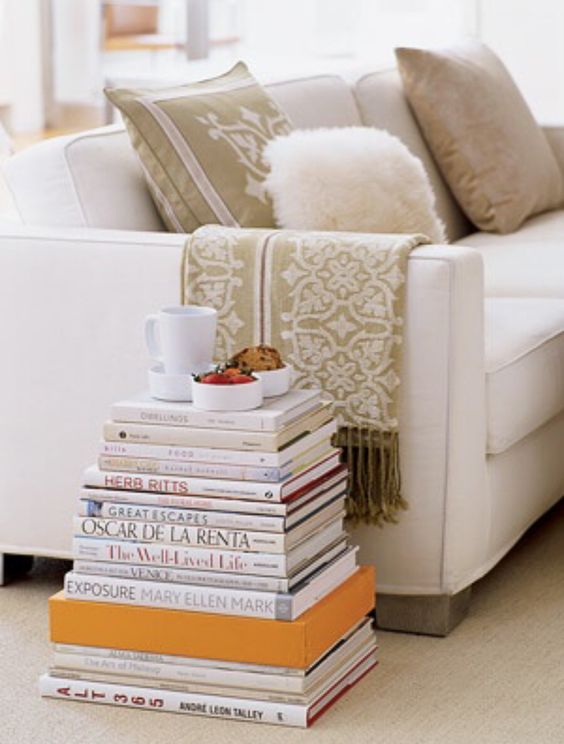
If you do not have the budget to buy a small coffee table to fill the side of the sofa in the living room, then just use the books in your cupboard. Pile up the books starting from the largest size at the bottom and working your way up to the smaller size. Stack the books until they reach the height you want. Use the top area as a place to put your snacks and a cup of hot chocolate.
This method also makes it easier for you to make your living room a relaxing place to read. You can take the book you want to read effortlessly. Very interesting, right?
3. Scent for The Air
Cc: Pinterest
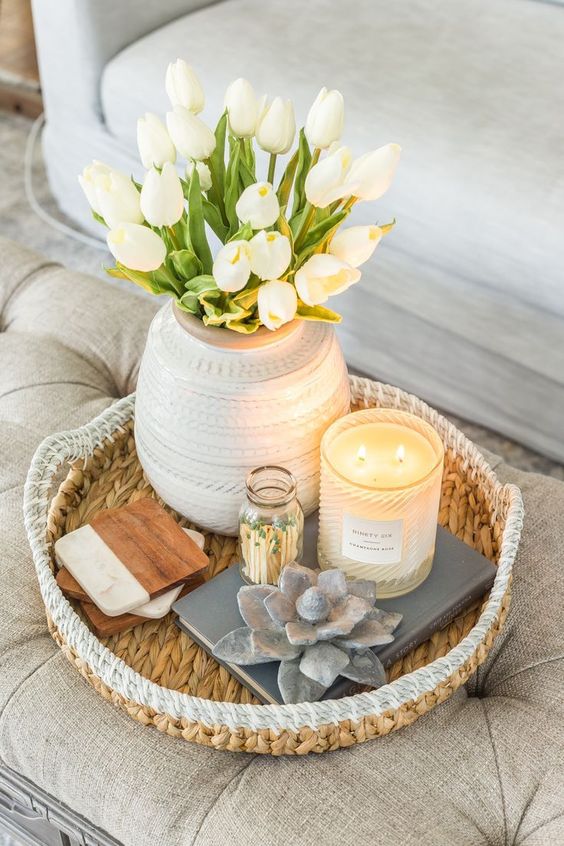
The next of 20 Simple Decorations That Will Enhance The Home Interior is to smell the air. Use aromatherapy candles for the room. The fragrance of aromatherapy candles will make you feel relaxed there. Or, you can also use beautiful and fresh flowers in the garden behind your house. Choose flowers with colors that match the interior. And, the most important thing is that the flowers must have a scent that you like.
Aromatherapy candles and flowers not only scent the air in the room but also become a display that can add aesthetic value. Especially if you can put both in the same container and place it in an area that is visible to the eye, such as a coffee table, bedside table, countertop, vanity, or cabinet table.
4. Leaning The Pictures on The Wall
Cc: Pinterest
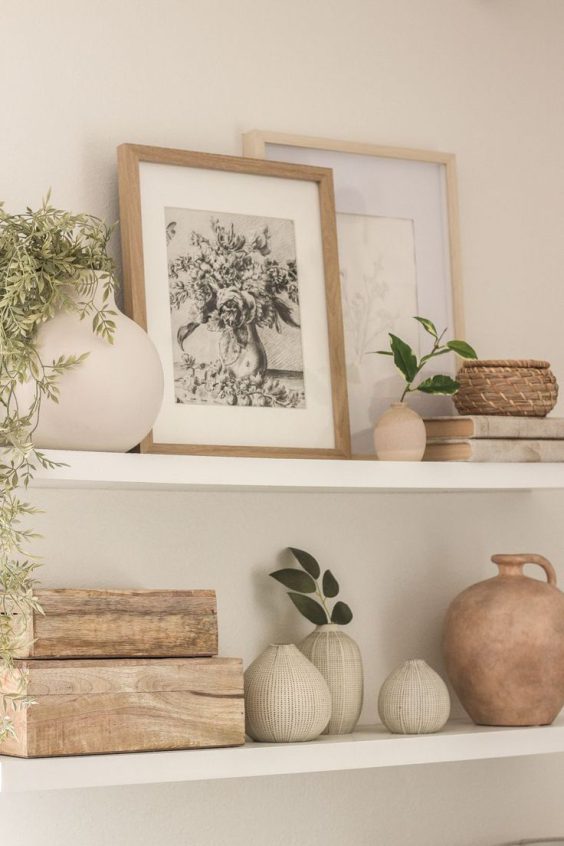
Do you still hang pictures on the wall? This method is very mainstream and also quite troublesome because you have to nail the wall first to be able to hang the pictures. There is another method that you can apply, that is by using floating wall shelves that are already on the walls of your room. You can put the pictures there by leaning them against the wall. Much easier and simpler, right? And also, the appearance provided is much more different and interesting to look at. Moreover, you can use other decorations such as small plants which can draw the eye’s attention directly to this decorative area.
5. A Large Christmas Tree
Cc: Pinterest
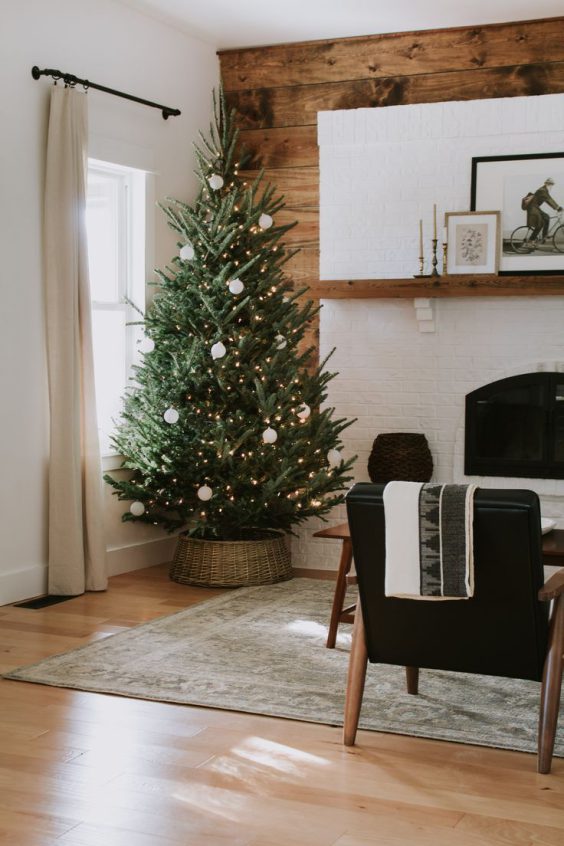
Welcome Christmas by decorating the room with a large Christmas tree. Seeing that its size is quite large, place this Christmas tree in a spot that is not disturbing, such as the corner of the room. This can also be an option as decoration to fill an empty corner of a room. This is the next of 20 Simple Decorations That Will Enhance The Home Interior.
Decorate the Christmas tree with various other Christmas ornaments such as Christmas balls. Choose colors that match the interior of the room for a simple and harmonious appearance.
6. Eco-Friendly Decoration for Kitchen
Cc: Pinterest
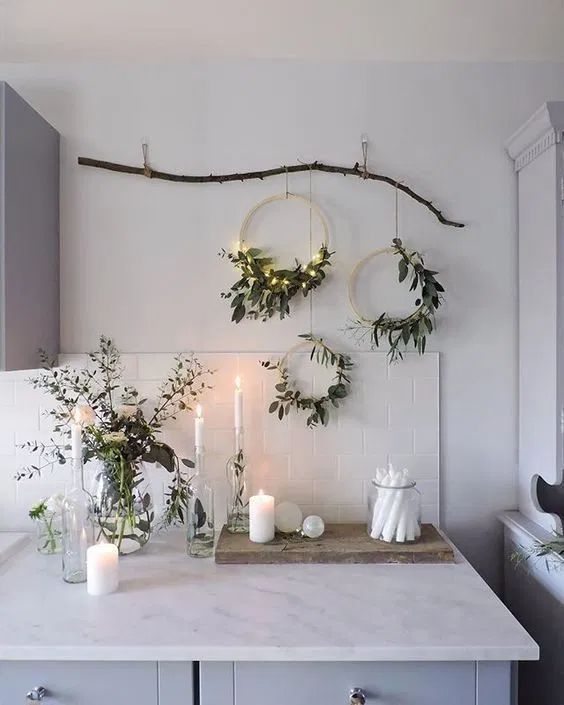
Decorating a room does not have to be expensive. You can save your budget for your other needs. And, in beautifying the space in your house, you can take advantage of what is in your garden. Look for wooden branches in the yard. Use a branch as a place to hang the wreaths.
Be as creative as possible. Pour your creativity here, like hanging wreaths at different heights. Or, install an LED light on one of the wreaths for a more stunning appearance. So, when the wreaths are hung on the wall, there is a very beautiful twinkling yellow light there.
7. Cover Corner Lines in The Room
Cc: Pinterest
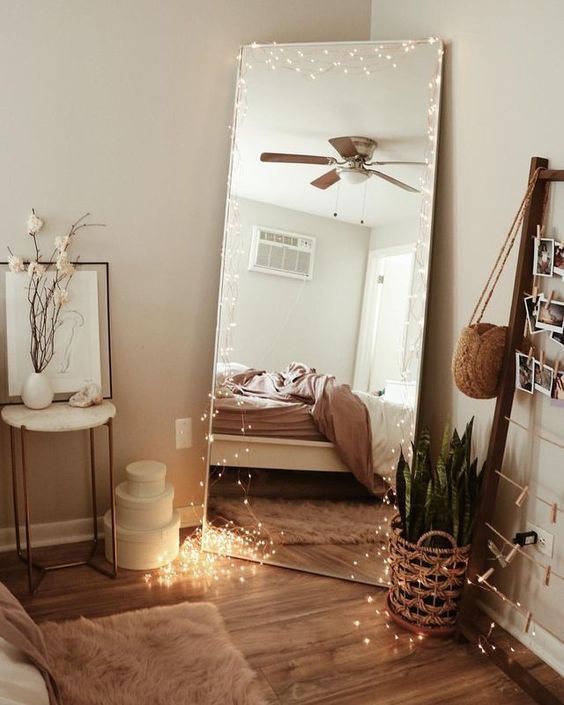
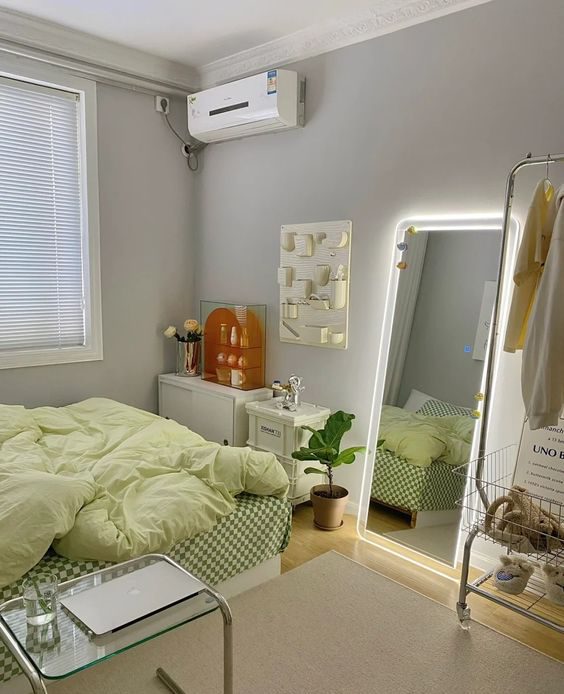
Perpendicular lines at the corners of the room give a stiff impression to the appearance. However, all of this can be circumvented by covering this stiff line with a standing mirror. This is the next of 20 Simple Decorations That Will Enhance The Home Interior that you can choose and follow. Closed perpendicular lines will give the effect of an endless room so that the room feels more spacious. Plus the reflection of your room in the mirror.
The standing mirror can also be an interesting spot in the room. It only needs a little touch in the form of a string light with yellow lighting. Install string lights on the edges of the mirror. It will look very beautiful at night and when the main lights are turned off.
8. Install String Light
Cc: Pinterest
String light is indeed the easiest item to find. There are many stores that sell this item. And this brings string lights into the 20 Simple Decorations That Will Enhance The Home Interior.
Installing string lights is quite easy, you just need to determine a spot for you to make an attractive area in the room. Even though this item is very easy, the effect it gives is quite big. The light from string lights can change the appearance of a room dramatically.
String lights with yellow lighting are the most appropriate to choose. Yellow light can bring warmth and calm which can increase the comfort of a room.
9. Scattered Candles
Cc: Pinterest
Bring deeper warmth into the room by using more candles so that you can use them as the main lighting at night. The yellow light from the fire burning in the candles is what changes the atmosphere of the room to become warm. And, not only that, candles also bring tranquility which increases the comfort of the room.
This decoration is very suitable for winter. The warmth from the candles will overcome the cold air. So, it is very appropriate to place candles in the fireplace area. That way, they can work together to warm the room and make it cozy.
10. Large Wreath for The Fireplace
Cc: Pinterest
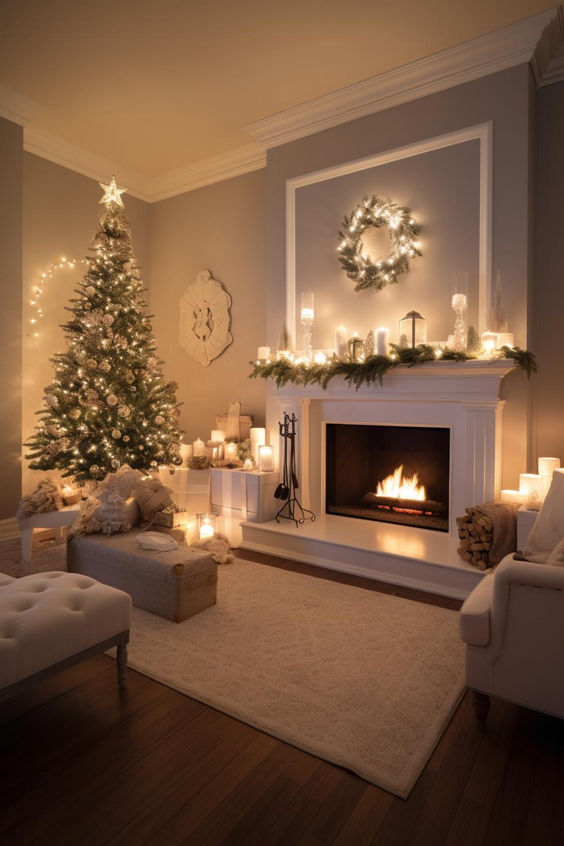
Make your Christmas day warm with a burning fireplace. Make the fireplace a source of warmth at home. And, to make it stand out in the living room, decorate the fireplace with several Christmas ornaments such as garlands, pinecones, string lights, Christmas balls, and wreaths. Don’t worry about decorating. You can fill the empty space on the wall above the fireplace with a large wreath. What you should focus on here is how to make the wreath a beautiful center of attention, for example, by hanging gold Christmas balls there, adding string lights to provide a beautiful twinkling light, or installing wall lamps with warm yellow lighting.
11. Floor Lamp for The Living Room
Cc: Pinterest
Take advantage of the comfortable sofa in your living room as a place to relax, whether it is sitting back, meditating, lying down, listening to music, or reading a book. Fill the sides of the sofa with beautiful decorations such as plants that can bring freshness or floor lamps that can be additional lights.
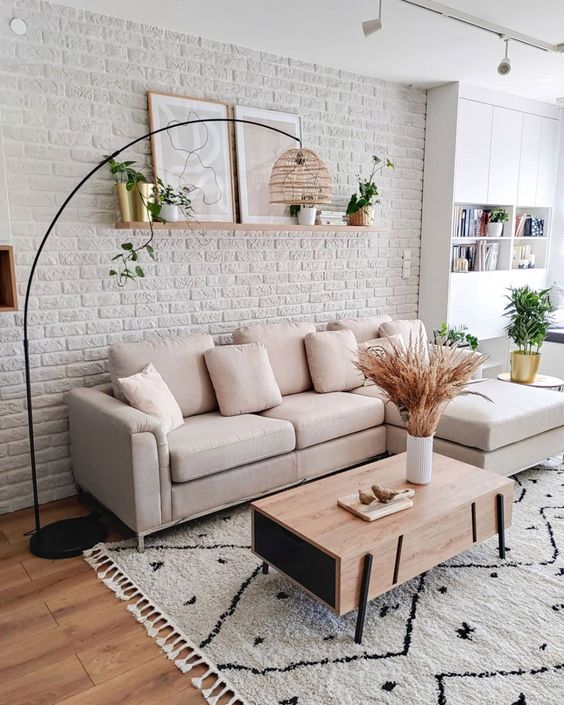
You can choose a floor lamp with a cup that leads directly to the sofa area, making it a comfortable place to read books at night. The curved lines from the floor lamp also sweeten the appearance of the room.
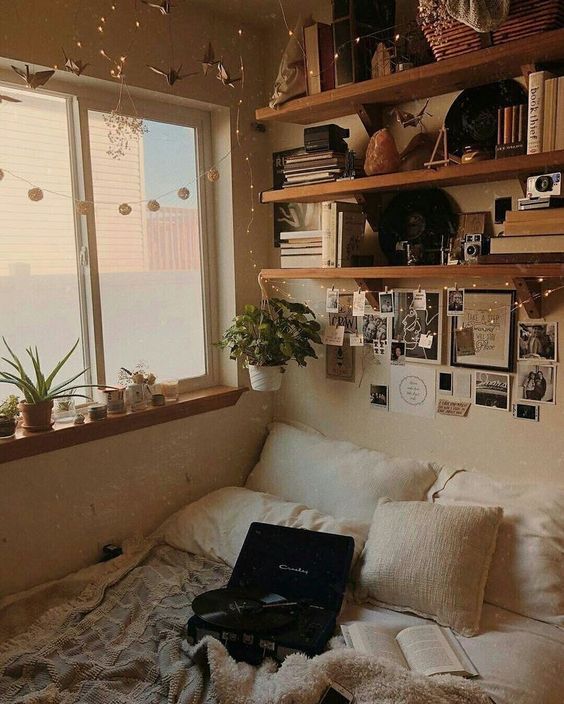
12. Show Off Your Memories on The Wall
Cc: Pinterest
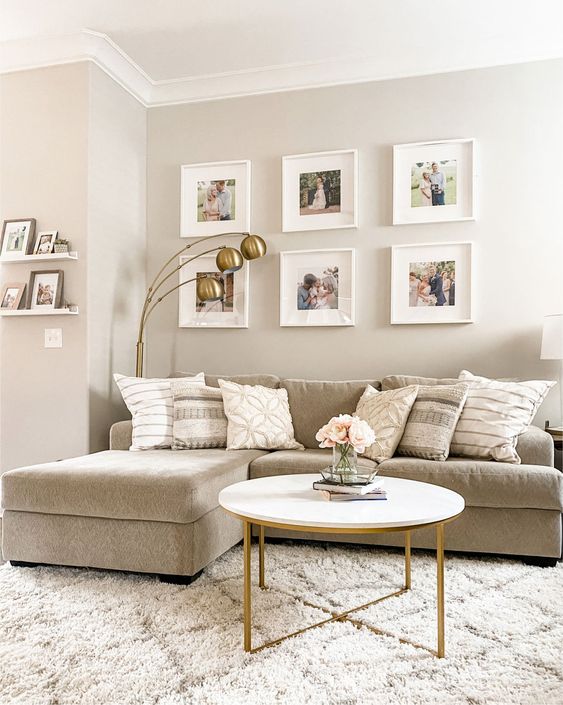
Making the walls plain can make your room minimalist. However, this can create a boring impression in the room. With this, decorate the wall area with something simple. Making a wall as a place to store memories is not a bad idea. This is the next of 20 Simple Decorations That Will Enhance The Home Interior.
The pictures are made smaller, showing a white background on the outer layer. And, to minimize the number of colors in the room, white frames were chosen for the pictures. Hang pictures at the same distance to make the room look neat and clean. With this, the presence of pictures as decoration will not disturb the minimalist concept of the room.
13. Two Gold Sconces
Cc: Pinterest
Want to beautify your room with displays but are worried about affecting the simple concept of the room itself? Then you can use items that are definitely in the room, such as lamps. There are two types of lights that you can use in a room, the first is the main light, and the second is additional light to sweeten the appearance.
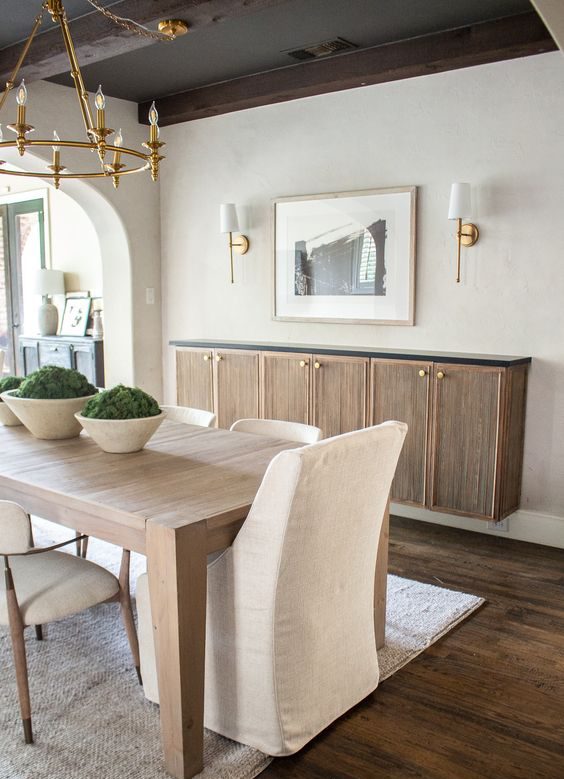
Sconces are the most appropriate wall decoration for the minimalist room. You can use these additional lights to enliven the wall. Hang the sconces on the right and left sides of the picture. Choosing colors that match the pendant lamps can maintain a harmonious appearance in the room.
14. Chess Pattern
Cc: Pinterest
Playing with patterns is a safe way to decorate a small room. You do not need to present other items which can take up space in the room and make it cramped.
Chess patterns can be used as an option. Black and white colors will blend with the interior of the room. These are neutral colors so there is no need to worry about clashes between colors.
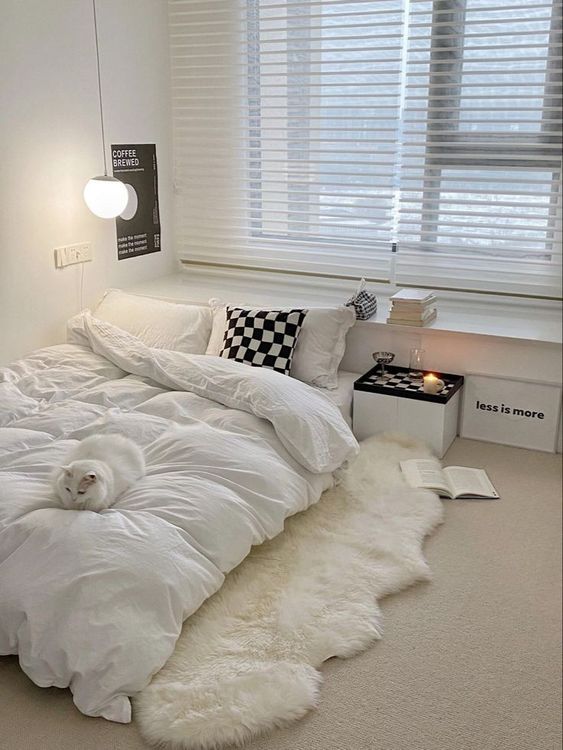
A black and white blanket with a chess pattern looks so beautiful on top of white bedding or white bedroom shades. Black gives a bold impression to a neutral room and also eliminates the stiff impression of the appearance.
15. Layered Bedding
Cc: Pinterest
The next of 20 Simple Decorations That Will Enhance The Home Interior is to do a layered bedding. This is the easiest decoration to do for beautifying the bedroom. Start from the thin deepest layer. And, the thicker the outer layer of the bedding becomes. You can also layer different textiles, colors, and patterns for a more interesting impression there.
Layered bedding not only beautifies the appearance of the bedroom but also adds to the comfort of the room. Layered bedding will make your bed feel warm so you can sleep more soundly, especially in winter. And, layered bedding also makes the bed feel softer.
16. Small Tent for Your Kids
Cc: Pinterest
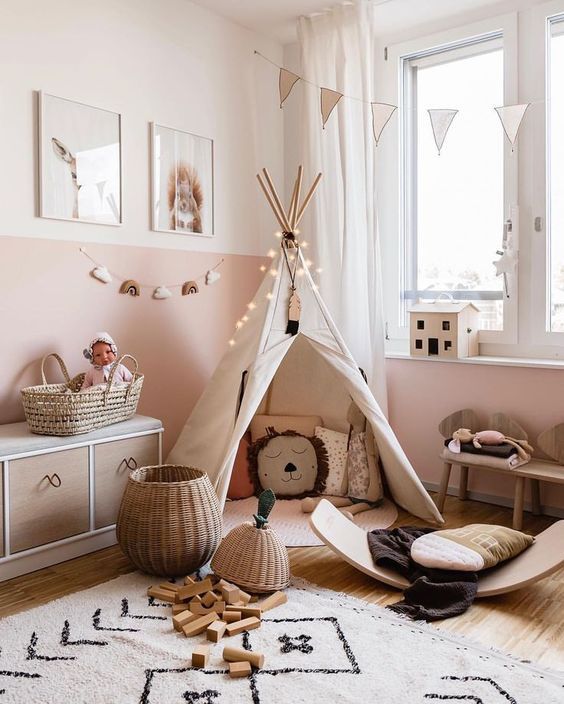
It would be much better to choose decorations that not only enhance the interior but also make it feel more comfortable, such as installing a small tent for the playroom. The small tent with the right design and color will beautify the appearance. This is also a children’s play area that can make your child feel at home in their playroom for a long time. Children’s imaginations will work and make the tent as if it were their home.
Make the tent look more beautiful and comfortable by adding additional touches in the form of seat cushions, dolls, throw pillows, and blankets. And, at the top, install string lights with yellow lighting to add a warm feel to the playroom.
17. Soft Throw Pillows
Cc: Pinterest
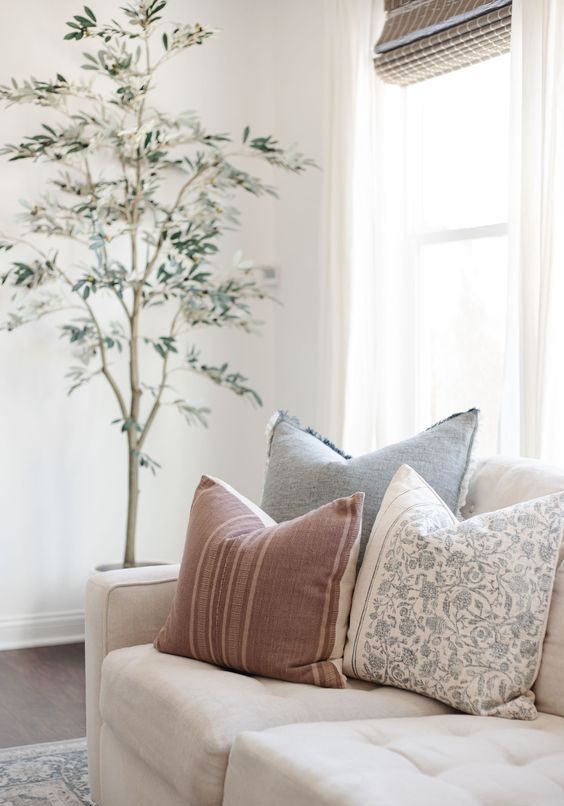
Make the main spot in the living room, which is the sofa, becomes a beautiful spot. Just decorate in a very simple way, namely by relying on throw pillows. This becomes the next of 20 Simple Decorations That Will Enhance The Home Interior.
The throw pillows with beautiful colors will work well and effortlessly in beautifying the room. Choosing soft-colored throw pillows will also soften the appearance.
Match the throw pillows to the living room interior design. For a living room with a minimalist and neutral design, throw pillows with simple patterns and soft lines can be an option.
18. Himayalan Salt Lamp for Bedside Table
Cc: Pinterest
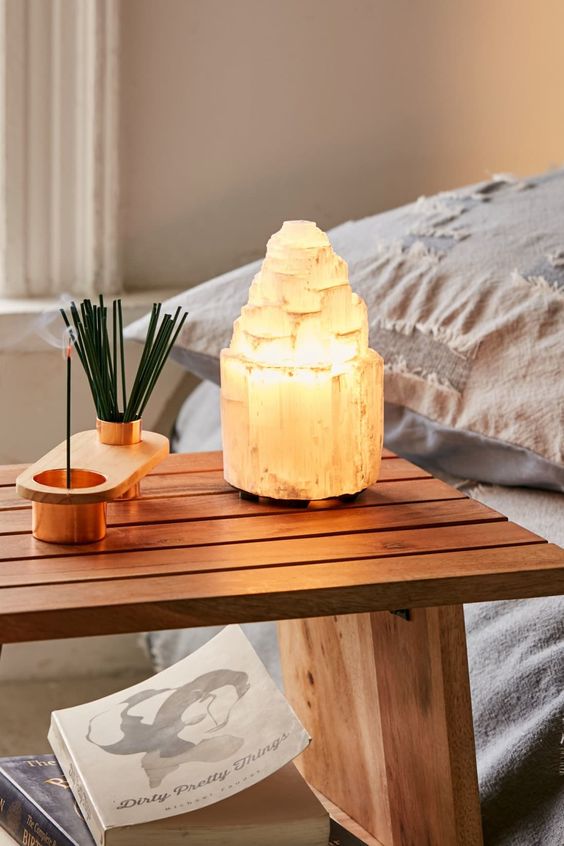
As a place to rest, comfort and beauty in the bedroom go hand in hand. Choose displays that not only add value in terms of aesthetics but also in terms of comfort. One of them is the Himalayan Salt Lamp.
Because of its small size, place the Himalayan salt lamp on the bedside table. Yellow lighting will bring warmth. Not only that, you can also use the Himalayan salt lamp as a night light.
Himalayan salt lamps are also very good for health. This light can move negative ions that neutralize toxins in the air we breathe. To know more about the benefits of Himalayan salt lamps for health, you can click here!
19. Use Turkey Carpet
Cc: Pinterest
If you do not want to use too many displays in your room, that is no problem. There are other simpler and easier ways to make a room look beautiful. And, one of them is by using Turkey carpet. The simple and distinctive motif can work well in the room. It is just that, here, you need to be careful in choosing colors. Choose a Turkey carpet with soft colors to maintain calm in your room.
Apart from color, size is also an important aspect that you must pay attention to when buying a Turkey carpet. Usually, Turkey carpets are large. Therefore, you need to measure your room first. Adjust the size of the room to the size of the carpet. Don’t let the size of the carpet you buy be too small or too big for the room.
20. Choose The Right Window Treatment
Cc: Pinterest
Choosing the right window treatment is the next of 20 Simple Decorations That Will Enhance The Home Interior. Choose curtains that match the design of your interior. The safest way is to choose curtains with colors that already exist in the room. That way it will be easier to maintain a harmonious appearance on the display.
Play with curtains to add aesthetic value to the room. You can use curtains with suitable materials. For example, thick and flowing material for an elegant room, or thin and light material for a calm, neutral room.
Hang the curtains above the window until the bottom touches the floor. This is a trick you can follow to make a room feel more spacious. This trick can create the illusion of height on the walls of the room.
Final Words
Beautifying your room does not need to be a hassle for you. With decorations that are simple and easy to apply, the room can look effortlessly beautiful. It’s just that, indeed, the decoration used must match the interior of the room. That way, they can enhance the room well. And, the points above are 20 Simple Decorations That Will Enhance The Home Interior that you can follow and apply. So, good luck!
In 2022, the average US household spent as much as $2,600 on furniture, home decor, and equipment.
A year prior, 70% of Americans had plans to redecorate their houses and apartments.
The US interior design workforce currently boasts 182 thousand professionals employed at 148 thousand companies scattered nationwide
If anything, these numbers prove the significance of interior design in our lives—and a strong intention to keep our homes stylish.
Among the factors driving the population’s interest in interior design was the COVID-19 pandemic, which was accompanied by a rapid shift to remote work and the shrinking size of American homes.
Despite this, many households struggle to decorate their homes in style due to the costs involved ($22,000 and counting).
Is there an affordable option to transform your dull apartment into a cozy environment that is suitable for both work and recreation?
There appears to be one. We’re talking about a glass partition for homes only.
Such partitions are sleek solutions made of various types of glass with different properties, either framed or frameless, with swinging or sliding doors, or without additional elements.
They won’t look out of place in a loft apartment or your grandma’s country house. They’re easy to install and clean. And they serve a multitude of purposes, from dividing your home into functional zones to sound-proofing your home office and keeping away kitchen odors.
Let us look into how this universal remedy can solve your interior design issues, transforming your drab apartment into a design magazine cover-worthy work of art.
5 Ways to Glam up Your Home with Glass Walls
Without further ado, here are five ways to spruce up your home with glass partitions:
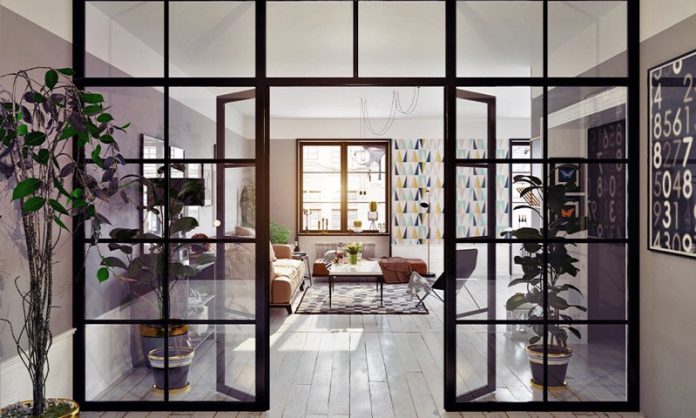
Set up a modern-looking office space. Given that nearly 13% of the workforce has already shifted to remote or hybrid work arrangements, creating a home office space is one of the most obvious applications for glass dividers. They not only allow more light into your home, which improves your mood and productivity, but also make your home office more orderly. Style-wise, there are many options for you to choose from. Frameless walls made of transparent glass better suit minimalist loft apartments. Enhanced with metal, wooden, or plastic frames, dividers help maintain airy, bright spaces in Scandinavian and industrial interiors. You can also experiment with tinted and patterned glass to match your interior’s overall theme and style.
Install elegant room dividers. Dividers help delineate different areas in open-floor-plan apartments and large rooms. For example, you could separate the living room from the kitchen and bedroom without blocking light or visibility. Similarly, you could use dividers for walk-in wardrobes, storage spaces, and hallways. Beautifully designed frames or etched glass could add an artistic touch to your interior while fulfilling the glass walls’ primary function—i.e., creating a better-organized living space.
Enhance your bathroom. Separating the bathroom and other wet areas of your home from the rest of the space serves a practical as well as an aesthetic purpose. On the one hand, glass walls will keep the damp at bay, saving your house from black mold. On the other hand, they will give your bathroom a futuristic, light-filled look (especially if you opt for corrugated panels without frames) and make the space feel larger.
Create an indoor greenhouse. Recent studies show that houseplants can be found in at least 66% of American homes. If you share this passion, too, you can use glass partitions to create a small indoor greenhouse or garden area right in your house or apartment, regardless of its size. The best place for it can be a sunny corner of your home. Glass dividers will protect your green babies from temperature fluctuations, maintain optimal humidity levels, and put the plants on full display, making them an essential component of your interior.
Use kitchen separations. In open-plan homes, a glass partition can be used to separate the kitchen from the living or dining room. This way, you’ll be able to contain cooking smells and noise without isolating the kitchen from the rest of the apartment. To save space in a small home, choose frameless sliding glass doors, pocket doors, or bi-fold dividers. For more spacious homes, you could purchase framed partitioning systems with classic swinging doors, which can be enhanced with decorative elements or incorporate different types of glass.
No matter which direction you choose to pursue, glass dividers will be a welcome addition to your interior, blending style and usability.
If you are hesitant to use glass dividers due to concerns about difficult installation and time-consuming maintenance, we will put your mind at ease.
If you take accurate measurements of your space and contact a reputable glass wall company, you will be able to install the partitioning system without the need for professional assistance—or relocate it if you decide to redecorate.
Glass dividers can be cleaned with standard alcohol-based window cleaning solutions and wipes. Your glass walls will always look fabulous if you dust them at least once a week.
And if you seek inspiration for your redesign project, check out the Instagram profiles of some interior design specialists, like Philippe Starck, David Hicks, and Jonathan Adler, who frequently incorporate mirrors and glass dividers into their projects to experiment with light and shape.
roohome.com– For Gen-Z or Millennials, the bedroom is everything. They can spend 24 hours in the bedroom. Therefore, comfort is the priority here. However, views about the comfort and appearance of the bedroom itself vary from person to person. This is because each person’s characteristics are also different. A comfortable bedroom must of course match its characteristics. Design and decoration must be made in harmony. And, in this article, we have provided 24 Teenager Bedroom Decors for Several Personal Characteristics. So, let’s check it out!
1. Look Minimalist and Manly
Cc: Pinterest
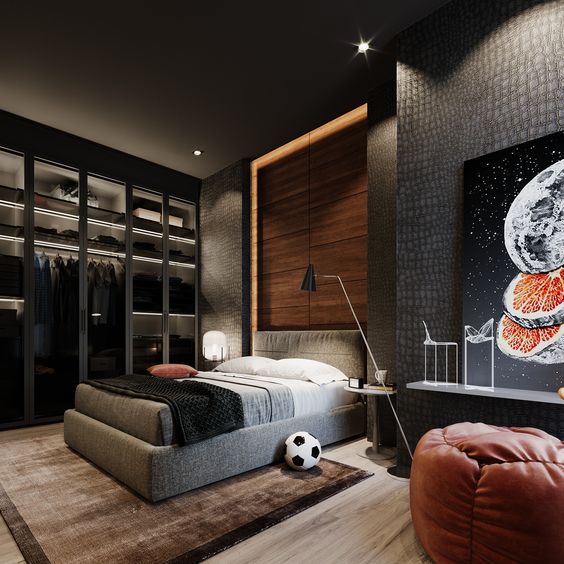
The minimalist and manly look is the first of 24 Teenager Bedroom Decors. Yup… that’s right. The manly look comes from black which is the main color. In order to make the appearance to be not dark and the room remains comfortable, excess lighting is needed. This is why this room has several lights ranging from LED light on the wall and wardrobe, recessed lighting fixtures in several spots, and a standing mirror that leads to the bed area.
Spotlights that directly hit the mural make the pattern and color clearly visible in the room. There is an orange color which is very influential in enlivening the atmosphere of the room. So, even though it is minimalist, the bedroom is far from feeling stiff and boring.
This idea will be suitable for those of you who like calm with dark nuances. Black as the main color is the key. Even so, the room still has a slightly bright impression from the use of light wood for the floor. And, the white bedframe also influences the brightness of the room.
To maintain the dark feel of the boho bedroom, the lighting chosen is not white lighting but yellow lighting. Also, the string light is the main light for this room so the lighting is not too perfect. For the window, there is a blind which is closed very neatly. It blocks the way light enters the room.
3. Feel The Calmness with Soft Forms
Cc: Pinterest
Feel the calmness with the soft forms is the next of 24 Teenager Bedroom Decors. This is very suitable if you have calm and simple characteristics. The room is only filled with two colors, those are white and light gray with beige tones, although the shades used are different. The combination of these two colors is very consistent, starting from the walls, ceiling, to the bedding. And, if there are other colors there, then these colors come from natural elements in the form of plants. The natural green brings freshness into the bedroom which adds to the comfort of the room. However, so that the green color does not disturb the soft concept of this room itself, only three small plants are used. And, the placement is scattered.
4. Make It Aesthetic with A Freshness
Cc: Pinterest
It would be better to choose decorations that not only focus on aesthetics but also on the comfort of the room. And, of the plenty of decorations you can choose, plants are the most appropriate. This is the safest decoration because it can fit into all types of room concepts and interiors.
Plants can change your ordinary room to be aesthetic and fresh. Place plants in several scattered spots so they can freshen up the room fairly. To save space in the bedroom, just use small plants and place them in spots that are visible to the eye. Or, you can also hang it on the wall or ceiling.
5. A Warm Pallete
Cc: Pinterest
The next of 24 Teenager Bedroom Decors is a warm palette. This is suitable for those of you who like calm and warmth in autumn. The colors used are the colors of autumn which are dominant with brown. And, if there are other colors, they are white and beige.
The look of the bedroom is still bright with white as the main color. However, applying brown color to the bedding, which is the main spot in the bedroom, makes it stand out. Other warmth comes in the form of wood and rattan materials for the floor and the pendant lamp. Also, the floor area is filled with carpet which makes the bedroom feel warmer and more comfortable.
6. Neon LED Lights
Cc: Pinterest
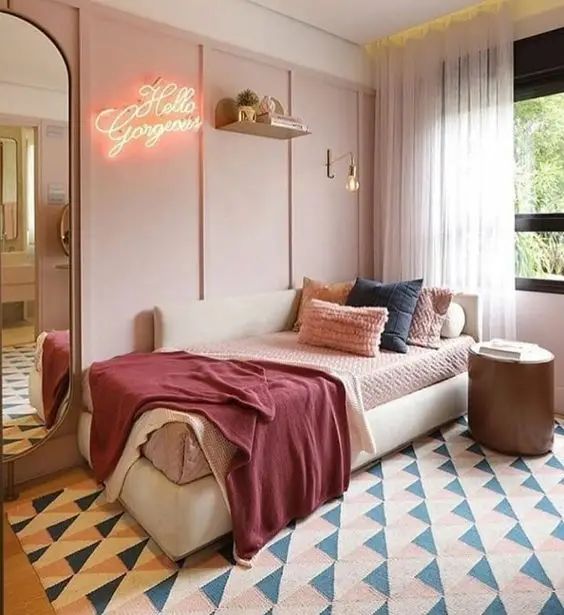
The wall panels actually no longer need to be decorated. The texture of the wall panel itself is quite interesting. However, if you want to make it seem more aesthetic and alive, then hanging a neon LED light is a great idea. This is the next of 24 Teenager Bedroom Decors you can choose from. You can customize a neon LED light with the words you want, whether it’s your name, positive sentences, and so on.
For lighting, just follow the color on the wall panel. For example, for the pink wall panel, the lighting for the neon LED light is pink too. It looks very simple but its presence manages to make the appearance aesthetic.
7. Playing with Lighting
Cc: Pinterest
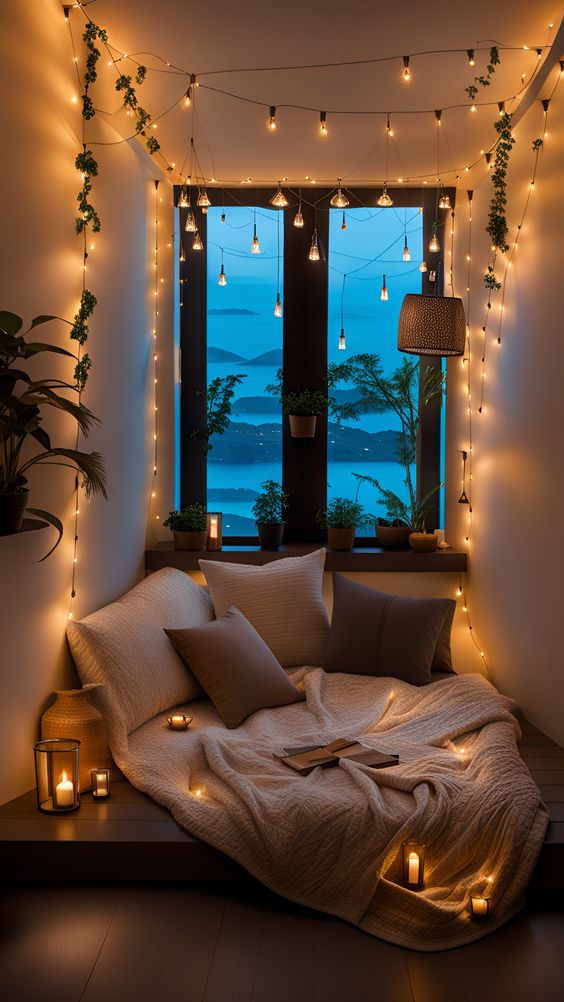
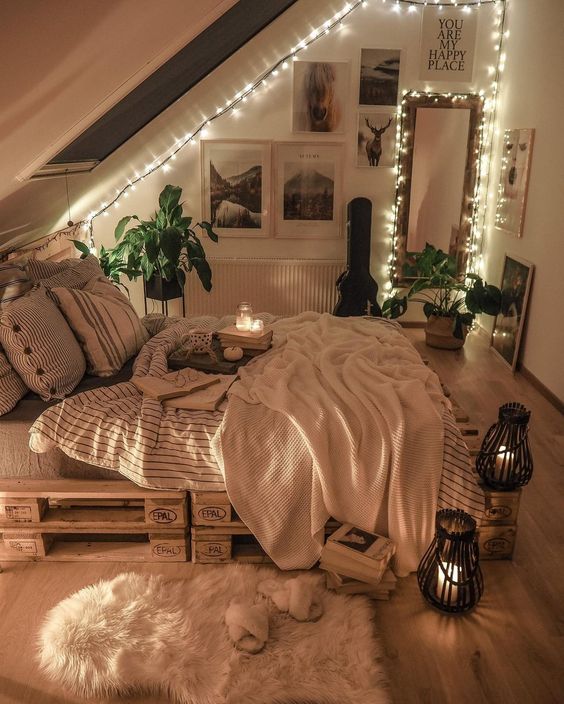
For the teenager, the bedroom does not require expensive and difficult decoration. Make your bedroom aesthetic on a budget and easy to do. Like this idea which only plays on lighting. On the side of the room is decorated with string lights with yellow lighting. In several spots, there are candles inside lanterns whose light blends with the string light. From these lights, the appearance of the room not only looks attractive but the atmosphere also becomes warmer and calmer. With this, Gen-Z and millennials can rest and laze around in the room for longer periods of time.
8. Look Minimalist and Natural
Cc: Pinterest
It doesn’t always have to look full, some teenagers also like their room to have a minimalist and natural appearance. And, if you are one of them, then this idea is very suitable for you to choose and implement.
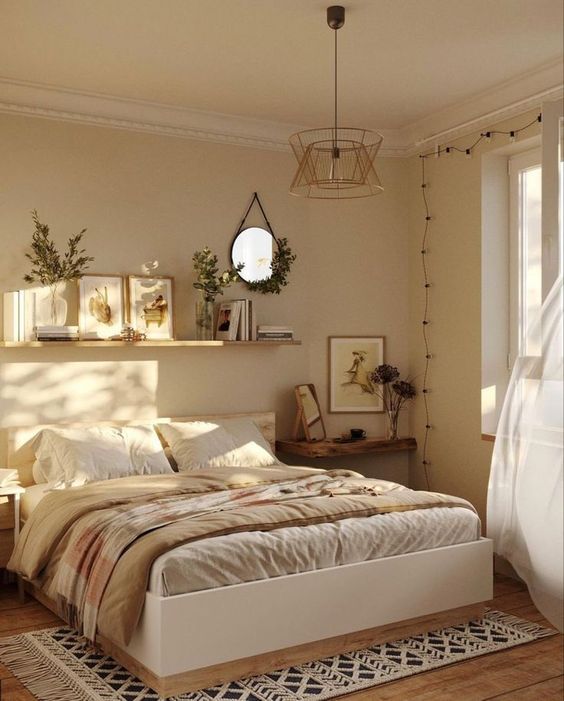
Instead of white, beige is actually a very suitable color choice as the main color of the room. This color can create calm and warmth which can boost your comfort. For decoration, just hang the floating wall shelf and put some displays such as pictures, books, and small plants. Extend the decoration to the bedside table. Also, cover the perpendicular line in one corner of the room with a string light. Rug adalah sentuhan terakhir yang membuat ruangan menjadi perfect. The simple pattern of the rug does not disturb the minimalist impression of the room itself. Instead, it gives a different look and enlivens the room well.
9. The Gaming Area in The Corner of The Room
Cc: Pinterest
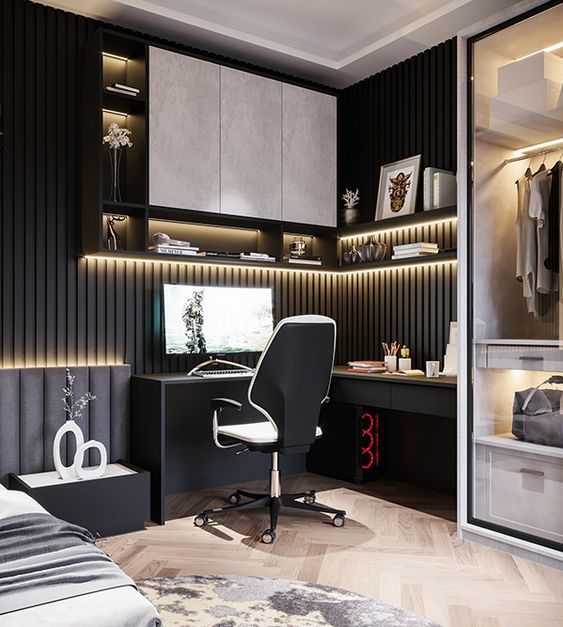
The teenager cannot be separated from online games. They can play games all day long. And, this can be used as inspiration in making a teenager’s bedroom a comfortable room. An empty corner of the room can be transformed into a comfortable gaming area.
Considering the size of the PC which is quite large, the gaming table must be made wider. You can customize an L-letter table where one space is for gaming and another one is for studying. The black floating wall shelves that are mismatched with the wall can be brightened up by installing LED lights with warm yellow lighting. Having light on the shelves will really help in showing off the displays on there.
10. Bunk Bed Safe More Space
Cc: Pinterest
Using a bunk bed is an alternative way to save space in the bedroom. This is very suitable for the small bedroom. Use the top area of the bunk bed as a bed for you to rest. And, the lower area is used as a storage area or study area. Or, you can also make it a place to relax by placing a sofa. Also, present a bookshelf there. And, done, the area under the bunk bed will be a comfortable place for reading your favorite book (reading nook). This becomes the next of 24 Teenager Bedroom Decors.
11. Wall Mural Enlivens The Room
Cc: Pinterest
Adults tend to make their bedrooms calm and comfortable with a minimalist concept. However, this is different for teenagers. The minimalist concept can still be applied to their bedroom. However, the ambiance of the room still has to be cloudless. This is why, there must be a special touch that can generate a cloudless atmosphere in the room. However, this touch should not make the room look full.
It’s difficult, but all of this can be resolved very well. Wall murals are the perfect solution for the minimalist teenager’s bedroom. The color of the wall mural must match the interior of the room itself. So there are no additional colors that can disturb the minimalist concept of the room. Also, it really helps in maintaining harmony in the look.
12. White Exposed Brick Wall as Accent
Cc: Pinterest
The accent on the wall can be an additional value that can beautify the appearance of the bedroom. Like this idea which uses white exposed brick walls on a small part of the bedroom wall. It becomes a decorative spot. The white color will blend more easily with the interior of the room so it does not disturb the appearance of the bedroom.
Make the white exposed brick wall look more stunning by hanging neon LED lights with white lighting and other displays that you like. Do it very simply so that the texture and lines on the exposed brick wall are not covered.
13. Modern Industrial Design
Cc: Pinterest
The modern industrial design already has a smoother surface. The appearance is also much brighter. The impression of cold and warm is more balanced. Also, there is an additional color besides the natural color, which is yellow. The touch of yellow on two sides of the bedroom walls brings a cloudless ambiance. The lighting is focused on the side of the wall to show the yellow color very clearly.
Concrete and exposed brick walls are still present in the room to emphasize the industrial design. The LED light installed at the top of the exposed brick wall makes the texture look clearer and more alive. So, even though the decoration in the bedroom is very minimal, the texture and color of the exposed brick wall itself are enough to beautify the appearance of the bedroom.
14. Save The Books Near The Bed
Cc: Pinterest
Some teenagers really like reading books before they sleep, ranging from motivational books, philosophy, to romance novels. And, to save energy and time, it would be better to store these books in a place close to the bed area. Like this idea, which installing floating wall shelves at the top of the wall as a place to store books. However, it is not just books, there are also several displays there which make the floating wall shelves also a decorative spot.
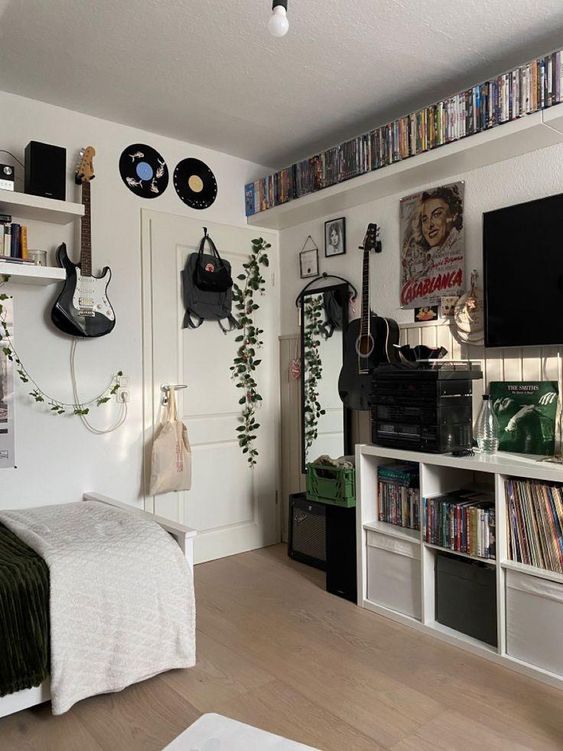
15. Take Advantage of Your Music Equipment
Cc: Pinterest
Music can be an inspiration in decorating a bedroom. For those of you who like music, then this idea will be very suitable for you. Start on the wall by sticking a poster of your favorite band or singer. For discs, install floating wall shelves at the top of the wall as a place to store all your discs. Show off your favorite vinyl on one side of the other wall. Also, hang several guitars in the empty space. It can help in enlivening the bedroom. And, for the final touch, if you feel the bedroom still looks stiff and unattractive, install vines on the wall. Green will really help in making all the colors on the walls blend together.
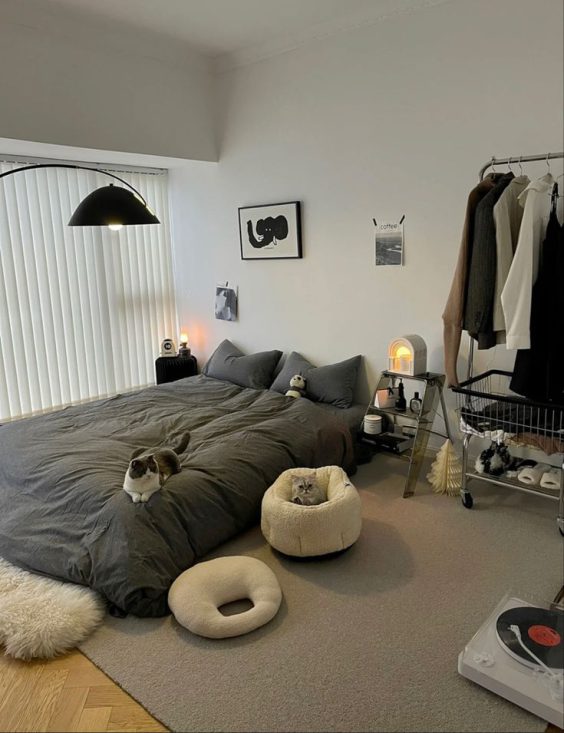
16. Minimalist, Simple, and Up-to-Date
Cc: Pinterest
The bedroom looks minimalist and simple by not using a bed frame. So, the bedroom walls look higher and make it feel more spacious. Also, the bed on the floor style felt much more comfortable. To keep it warm, there is a rug at the bottom. Apart from that, layered bedding is also used which also makes the mattress feel softer. With this, the bed will feel more comfortable. And, its warmth can be a bulwark against cold air when winter arrives.
The small furniture such as a bedside table and clothes rack is more suitable for this one bedroom concept. Because there is no bedframe, the bedside table cannot be too big. The height and width of the bedside table must match the bed.
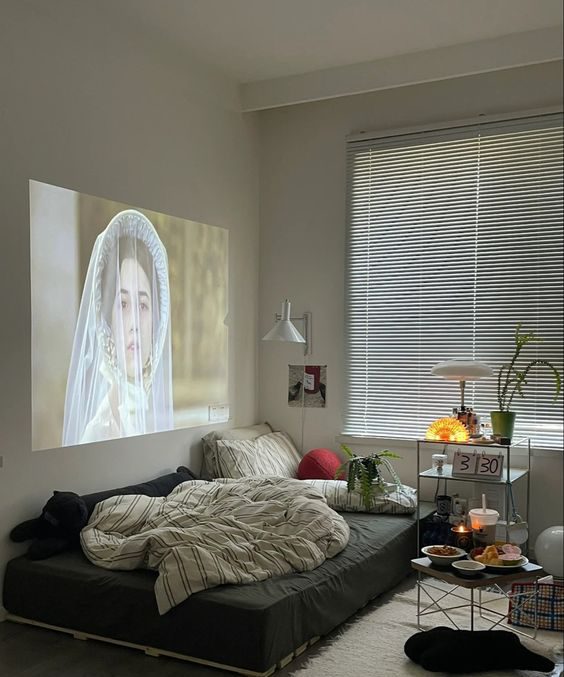
17. Let’s Chill in Your Room
Cc: Pinterest
For the teenager, the bedroom is not only a room for sleeping but also a place to rest and chill in your free time by playing social media or watching films. Instead of watching on a laptop or cellphone, it will be much more comfortable to watch on a big screen. With this, the projector becomes a very important item. And, this is the next of 24 Teenager Bedroom Decors.
Point the projector at an empty wall. The whitewashed wall is the right background. Next, you only need to adjust the position of the bed. Or, you can also use the carpet as a place to sit. Watching films while enjoying instant noodles will be more fun.
18. LED Light Standing Mirror
Cc: Pinterest
The LED light standing mirror becomes the next of 24 Teenager Bedroom Decors. Place this item on the side of the room or in a corner of the room where it can cover straight lines. That way, the bedroom will feel more spacious.
One of the advantages you can get from using an LED light standing mirror is additional light for the bedroom. Or, you can also use it as a light at night (sleeping light). Besides that, in terms of appearance, this item really changes your bedroom to be more aesthetically pleasing.
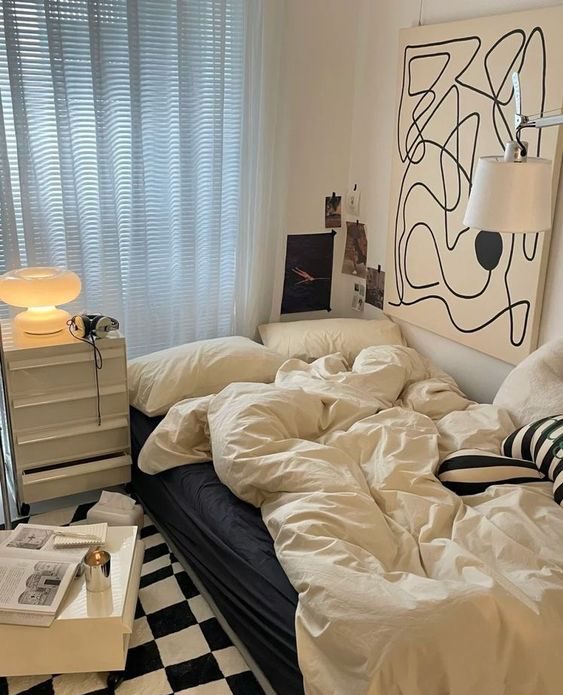
19. Large Line Painting
Cc: Pinterest
The simple impression can be seen very clearly from the use of only two colors, those are black and white. Also, the minimalist decoration looks very consistent here. The whitewashed wall looks so simple with only a large painting hanging there. To maintain simplicity in appearance, no frame is used for the painting. Even so, the different shade of white still makes it not look like it blends with the wall.
The pattern of the painting is also very well noticed. Black and white are the colors that are focused on here. In fact, the painting used only consists of these two colors. The black line pattern is perfect to fill this minimalist bedroom.
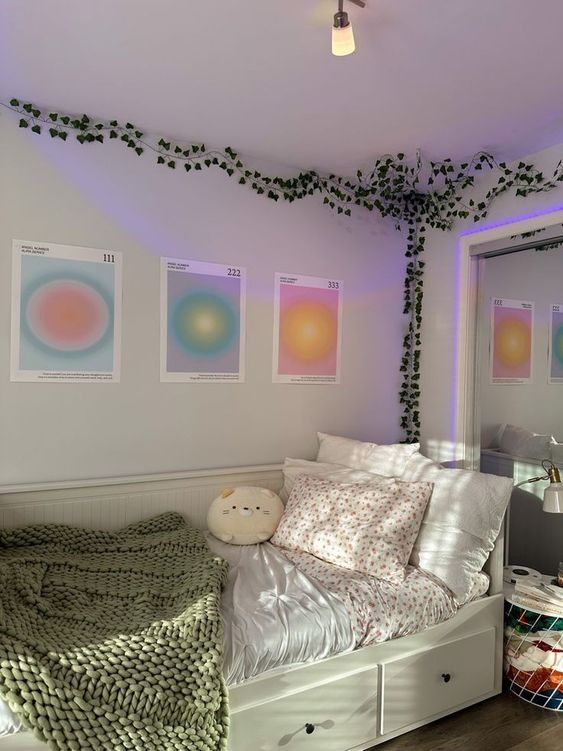
20. Synthetic Vines for The Wall
Cc: Pinterest
The look of the bedroom looks plain and stiff. However, all of this is resolved with a touch of green from synthetic vines. Installing it on the whitewashed wall makes the green color successfully stand out in the room. It brings a freshness that increases the comfort.
The installation is simple and conceptual to maintain a simple impression in this bedroom. That way, calm can be maintained very well. The vines are only installed on the lines on the wall. This is also a trick to cover perpendicular lines which can give a stiff impression to the bedroom. So, the room will remain smooth.
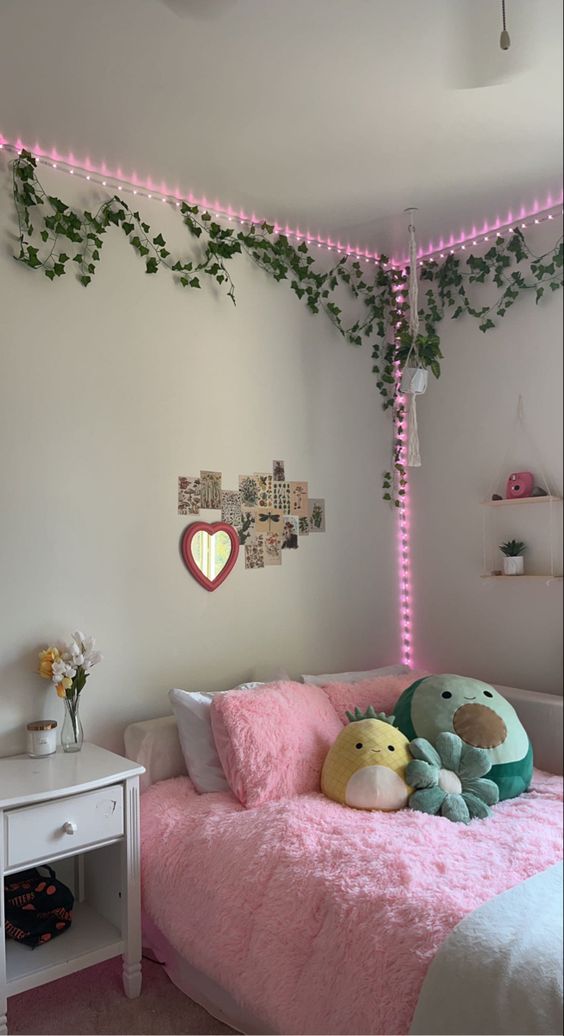
21. Cute Dolls on The Bed
Cc: Pinterest
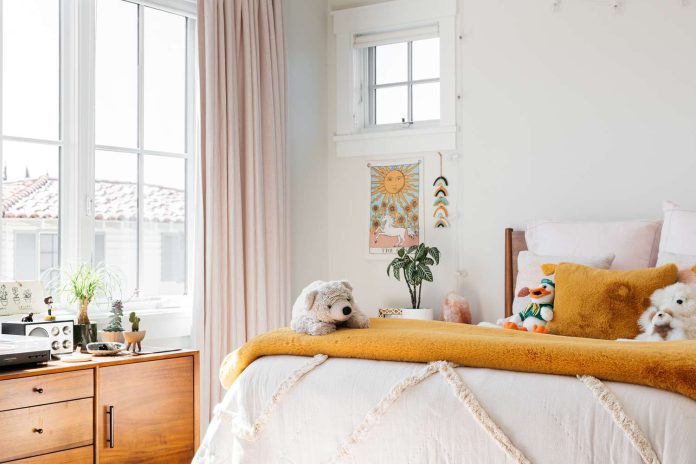
Cute dolls on the bed are the next of 24 Teenager Bedroom Decors. This decoration is very suitable for a woman’s bedroom. The pink bedding is very attractive with three dolls. Even though the dolls have other colors that are not in the room, this does not disturb the concept of the interior itself. In fact, the presence of other colors on the doll brings a cloudless atmosphere.
Even though it is cute and looks attractive, the position or placement of the doll on the bed must be carefully considered. Don’t let the presence of dolls give a messy effect on your bedroom.
22. Save Your Memory on The Wall
Cc: Pinterest
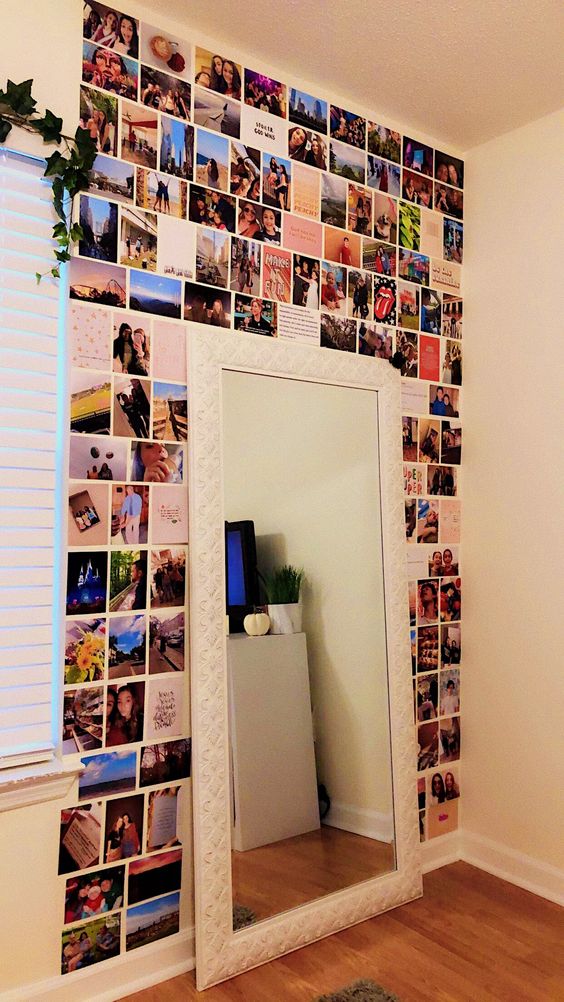
Don’t save your photos on the camera on the memory. Take advantage of these memorable photos as decorations for the bedroom. Print the photos at the same size. Paste all these photos centrally by choosing one spot to use as your memory spot. And, the corner of the room is a very suitable spot.
Don’t just rely on photos to decorate the corners of the room. Use additional items such as standing mirrors. So, attach your photos like they surround a standing mirror. It would be great if you could install additional lights such as LED lights or string lights. The lighting of these lamps can make the photos stand out even at night.
23. Purple LED Light
Cc: Pinterest
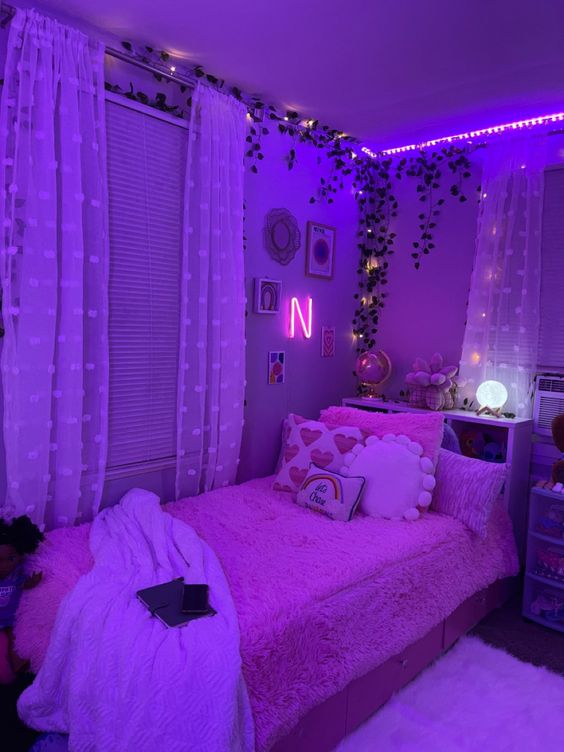
White and yellow light is very mainstream for the room. So, for a different look, of course, you have to take bold action. Use lights with other lights such as purple. Currently, there are many purple LED lights sold in online stores at low prices.
Installing purple LED light on the lines where the ceiling and walls meet not only covers the perpendicular lines which make the room stiff but also allows the light to spread very well in the room. And, you can use this light as a lamp to accompany you to sleep.
24. String Light to Hang The Photos
Cc: Pinterest
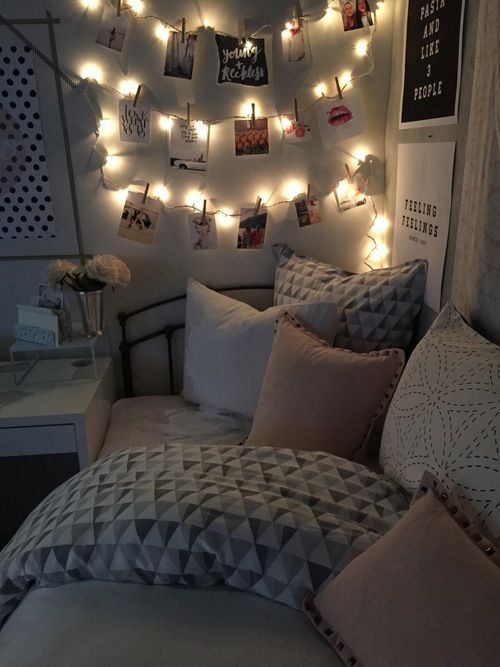
The last of 24 Teenager Bedroom Decors is a string light to hang the photos. This is another way to bring memories into the bedroom. You do not need to bother pasting your photos. Just hang the photos on the string light. And, let the light from the string lights help these photos stand out at night. Hang the photos neatly. Use this as decoration to add to your aesthetic value.
Final Words
There are many differences between decorating an adult’s bedroom and a teenager’s bedroom. For the teenager bedroom is not only concerned with comfort but also aesthetics and atmosphere. The teenager prefers the atmosphere of their bedroom to be more cloudless. Therefore, there are special decorations required. And, the points above are 24 Teenager Bedroom Decors. All of these decorations depend on the characteristics. A comfortable bedroom is a bedroom that matches its characteristics. So, make sure you choose the right decoration. Good luck everyone!
From fixing broken bones to replacing worn-out joints, medical devices play a crucial role in modern healthcare.
With the industry experiencing exponential growth, understanding the most popular materials enabling precise diagnoses and life-saving treatments is key. These materials allow incredible miniaturization and increase the reliability of products like pacemakers and glucose monitors.
However, issues can also arise when substandard materials are used or the materials degrade over time, thus, necessitating careful testing and monitoring. In this article, we will discuss the seven most commonly used materials in medical device manufacturing, their advantages and limitations, and their impact on patient safety.
Metals
Metal alloys are one of the most commonly used components in medical device manufacturing. Think of them as the skeleton frame behind those remarkable medical devices. They offer excellent strength, durability, and biocompatibility, making them ideal for multiple applications.
Examples of medical devices made from metal alloys include orthopedic implants, pacemakers, and dental implants. Titanium stands out for its exceptional strength and biocompatibility, which makes it suitable for dental implants, bone fixation devices, and joint replacements. Stainless steel, on the other hand, is known for its permanence and corrosion resistivity. It is used extensively in surgical instruments and permanent implants.
However, no metal is perfect—stresses may enable corrosion over time, and accumulated wear debris can prompt inflammatory reactions, necessitating implant replacement.
Companies must sufficiently test candidate metals for a given application early on to ensure adequate biocompatibility, hardness, and endurance to elongation/cracking over projected lifetimes. Unexpected issues have arisen in the past with hip implants shedding metallic debris through wear, causing device early failures.
According to TorHoerman Law, there have been concerns about the safety of Exactech hip, knee, and ankle implants. The Exatech lawsuit alleges that certain Exactech implants have caused serious injuries such as bone loss and degradation, swelling, and chronic joint pain.
Polymers and Plastics
Polymers and plastics offer unparalleled versatility as they can mimic human tissues, bend like rubber, and withstand heat. Thus, they are used in various medical devices, including catheters, sutures, syringes, and implantable devices.
Polymers like polyethylene and polypropylene boast customizable properties, catering to a diverse range of medical device needs. These materials find application in prosthetics, implants, and disposable medical items due to their adaptability and biocompatibility.
Similarly, plastics, known for their lightweight nature and elasticity, are used in packaging, disposable medical products, and specific implantable devices. Polyether ether ketone (PEEK), a superpowered plastic, is used in spinal implants, thanks to its strength, high heat resistance, and diagnostic imaging compatibility.
However, there are also safety considerations associated with the use of polymers and plastics in medical devices. The risks include the leaking of chemicals into the body, accelerated component aging and brittleness due to heat, and the potential for bacterial growth.
It’s important to highlight certain products, like the Bard Power Port. This medical device, commonly used for intravenous access, is facing scrutiny for fracturing, leaks, and catheter breaks requiring surgical removal procedures. This resulted in a Bard Power Port lawsuit, which claims that certain Bard Power Port catheters can cause serious injuries and health complications.
Ceramics
Ceramics like zirconia and alumina find increasing adoption in bone screws, hip, knee, and dental replacements due to durability, biocompatibility, high corrosion resistance, and bone-bonding tendencies.
However, hardness and brittleness tradeoffs still apply. There’s always a risk of micro-cracks due to routine load impacts or sudden trauma, which leads to fractures if not detected early. Replacement challenges also exist—should ceramic components crack years later, juxtaposed bone and tissue may hinder modular component replacements.
Composites
Composites are materials made from two or more different substances, such as polymers and ceramics. They offer a combination of properties that cannot be achieved with a single material, such as high strength and low weight.
Composites also retain polymer benefits like flexibility and bio-stability, while enhancing wear resistance and bone in-growth potential from added particles. They are used in various medical devices, including prosthetics, implants, orthotics, and surgical instruments.
However, composites aren’t without faults. The same implant design can display drastically different characteristics depending on how it’s manufactured. Minor differences in mixing the components can lead to drastic changes in flexibility, wear, and bone growth.
Manufacturers need strict quality testing to catch issues early. Or else it will be an issue down the road which may further need replacement surgeries.
Biomaterials
Biological materials, such as tissues, absorbable sutures, breast implants, and artificial organs, are used in place of damaged tissues or organs. They can also be used to heal some damaged body parts.
Biomaterials play a crucial role in various medical applications, from tissue engineering to implantable devices, contributing to advancements in regenerative medicine and personalized healthcare solutions. However, there are also challenges of biological materials, such as the risk of infection, rejection, and wear and tear.
Paper and Other Fibers
While less common in medical device manufacturing, paper, and certain fibers find niche applications in specific medical contexts.
For instance, sterilized paper is utilized in packaging and as a disposable barrier in medical settings due to its affordability and ease of disposal. Similarly, cotton and silk are used in biocompatible suture thread materials. However, any variation in the natural raw goods can produce inconsistencies.
Moreover, organic fibers risk quicker biodegradation when compared to stable, long-lasting synthetic fibers. Yet, some improved natural fibers are eco-friendly choices that work well for medical devices meant for short-term use.
In conclusion, the materials used in medical device manufacturing are diverse and essential for the functionality and safety of these devices.
Metals, polymers and plastics, ceramics, composites, and biological materials each offer unique advantages and face specific limitations. Medical devices have come a long way, and the future looks even brighter.
With continuous research and responsible manufacturing, newer and better materials will further advance healthcare outcomes while minimizing risks. However, reasonable safety vigilance from regulators, manufacturers, and patients remains vital—though rare, some issues only arise years after device approvals, underscoring that safety is an enduring process, not a one-time event.
Situated in the heart of Michigan, Portage is known for its beautiful trails, scenic parks, and a strong sense of community. It’s a city where homeowners take pride in their living spaces, seeing them not just as houses but as homes filled with memories and potential. In Portage, and indeed in any city, remodeling your home can be a game changer. It’s more than just altering your living space; it’s about enhancing your quality of life.
Whether it’s updating an outdated kitchen, adding more space, or simply giving your home a fresh new look, remodeling has numerous benefits. This article dives into the top reasons why homeowners should consider remodeling their homes. From increasing your home’s value to tailoring it to your evolving lifestyle, let’s explore why remodeling is not just a luxury but often a necessity.
1. Increase Home Value
Remodeling is a strategic investment. Updating critical areas like kitchens with modern appliances or transforming bathrooms can offer substantial returns if you decide to sell. Even smaller upgrades, like fresh paint or new flooring, can make your home more attractive to potential buyers. It’s important to research which renovations yield the best return in your area.
2. Upgrade for Luxury and Pleasure
Remodeling provides an opportunity to add luxury elements to your home that enhance your day-to-day life. This could involve creating a gourmet kitchen for those who love to cook, designing a custom home theater for movie enthusiasts, or building a spa-like bathroom for ultimate relaxation. For example, working with Portage bathroom remodeling experts like All Weather Seal can ensure high-quality, luxurious upgrades tailored to your specific desires and needs.
3. Improve Functionality and Efficiency
As your life changes, so do your home needs. Maybe you need a home office, a larger kitchen, or more entertainment space. Remodeling allows you to reconfigure your home to suit these evolving needs. It’s also an opportunity to replace old, inefficient appliances with newer, energy-saving models, which can reduce your environmental impact and save on utility bills.
4. Enhance Energy Efficiency
Energy efficiency is not just good for the planet; it’s good for your wallet, too. Upgrading to energy-efficient windows and doors, adding more insulation, or installing a more efficient heating and cooling system can significantly lower your energy consumption. These changes can lead to substantial savings over time and make your home more comfortable in extreme weather.
5. Update the Style
Trends in home design change, and what was in vogue a decade ago might now feel dated. Remodeling gives you the chance to bring your home’s style into the current day. Whether it’s embracing an open floor plan, updating to a contemporary kitchen, or adding smart home features, these changes can rejuvenate your home and make it feel new.
6. Improve Comfort and Safety
Your home should be your sanctuary, and remodeling can greatly enhance the comfort and safety of your living space. This could include improving indoor air quality through better ventilation systems, installing new lighting for a brighter and more welcoming environment, or updating old wiring and plumbing to meet current safety standards.
7. Maximize Space
Making the most of every square foot is crucial, especially in smaller homes. Remodeling can help you maximize space through clever design. This might involve opening up walls to create more fluid, open living areas, adding built-in shelves for smart storage solutions, or converting unused spaces like basements or attics into functional areas such as guest rooms or home gyms.
8. Address Aging-in-Place Needs
For those planning to stay in their homes long-term, remodeling for aging-in-place can be essential. This may include installing no-step entries, widening doorways for wheelchair access, or remodeling a bathroom to be more accessible with walk-in tubs or showers. These adjustments allow for increased mobility and safety, ensuring comfort in your home through all stages of life.
9. Repair and Maintenance
Regular maintenance and timely repairs are crucial for preserving the integrity and longevity of your home. Remodeling offers the chance to address these needs comprehensively. This might mean replacing an old roof, updating electrical wiring, or fixing plumbing issues. Proactive maintenance through remodeling can prevent larger, more costly problems down the road.
10. Prepare for Changing Family Dynamics
As families grow and change, their space needs often evolve. Remodeling can adapt your home to these changes. This might mean adding a bedroom for a new child, creating a private space for a returning college student, or even adjusting your home layout to better host gatherings and family events. These modifications ensure your home continues to be a comfortable and functional space for the entire family.
11. Enhance Outdoor Living
Improving your home’s outdoor space can significantly enhance your living experience. This could include landscaping for better curb appeal, constructing a deck or patio for outdoor dining, or even creating a serene garden space for relaxation. Outdoor remodeling projects not only improve your home’s aesthetic but also extend your living space into the outdoors, offering new areas for leisure and entertainment.
12. Personal Satisfaction and Achievement
Lastly, completing a home remodeling project can bring immense personal satisfaction and a sense of achievement. Transforming your space to reflect your personal style, meet your needs, and enhance your lifestyle can be incredibly rewarding. It’s a chance to put a personal stamp on your home and create a space that brings you joy and comfort every day.
Conclusion
Remodeling your home in Portage, MI, or anywhere else, offers numerous benefits. It’s an investment in your property, your comfort, and your lifestyle. Whether you’re looking to increase your home’s value, improve functionality, or simply want a change, remodeling can be an exciting and rewarding endeavor. With careful planning, the right team, and a clear vision, your home remodeling project can transform your living space into the home of your dreams.
HVAC systems are crucial components in various types of buildings, including single-family houses, flats, and commercial spaces. HVAC units heat and cool interior air using furnaces, air conditioners or heat pumps connected to ductwork with thermostat controls and thermostats.
Smart technology adds a level of intelligence to home systems. Together with sensors, smart home devices can optimize spaces according to each owner’s lifestyle and goals.
If you want to upgrade your HVAC system with smart tech that tailors your comfort, River Valley Air Conditioning is worth checking out! You can call them at +1 928-768-2122 or visit the office: 5107 AZ-95, Fort Mohave, AZ 86426. They offer solutions that can optimize your space and lifestyle.
Here’s a look at how your smart thermostat can improve your HVAC unit.
How your thermostat integrates with your home
Smart thermostats use data gathered on the heating and cooling preferences of a homeowner to create personalized settings to reduce energy consumption and costs, thus cutting utility bills while decreasing environmental impact.
Some smart systems can integrate with other devices like humidifiers or air purifiers, to enhance indoor air quality and comfort. Also compatible with smart systems are doorbells, alarms and blinds, allowing for convenient control from one convenient app on smartphones or other devices.
Smart thermostats often integrate with voice-activated assistants like Amazon Alexa or Google Assistant for hands-free temperature adjustment and question-answering without grabbing your phone and opening an app.
Smart HVAC systems can also connect to a hub to seamlessly operate with other smart home devices, streamlining their operation.
For instance, using one app, you can control all your smart thermostats, lights and locks from one location – saving time from checking multiple settings or manually configuring each device individually while also helping stay organized by creating timelines of events and reminders about upcoming maintenance needs.
It operates through sensors
The optimal sensors are essential if you want your smart HVAC system to make informed decisions. To take action based on data, smart IoT appliances use sensors to identify changes in their surroundings and communicate this information back to the control panel or app.
Motion sensors utilize infrared detectors to sense movement in an area and convert any detected changes into electrical signals for controlling devices like lights or fans. Other types of sensors, known as occupancy detectors, detect the presence of people within a room and adjust HVAC controls accordingly to save energy and ensure comfort in homes where people reside.
Intelligent HVAC systems use sensors to measure the temperature in each room by closing or opening vents based on their temperature and desired thermostat settings.
This enables residents of a home or office to find more comfortable living conditions more quickly by easily finding their ideal temperature setting.
Smart ventilation works well when combined with other devices, like smart blinds, to further improve comfort and energy efficiency. When it’s sunny outside, these blinds can close to reduce heat from sunlight and lighten the load on the AC, while at night, they open to allow natural lighting into the room for lighting purposes.
Provides remote access to more than just your HVAC system
No matter where you are – skiing on the slopes or in your home office – smart air conditioning settings can easily be adjusted through mobile apps. And with geofencing features, you can turn off the system when you’re leaving.
These advanced capabilities are made possible thanks to the smart technology embedded within your HVAC equipment. A “brain” is installed within your smart home HVAC system that can take input from sensors, analyze it and trigger appropriate actions based on predefined triggers – this makes your smart device more than just a Wi-Fi-enabled appliance!
Additionally, smart HVAC systems can communicate with other gadgets in your house, such as lights and blinds. For instance, during hot days, they could close blinds to reduce heat gain and ease the load on the AC unit; on colder days, however, they could open them to allow sunlight in for natural heating purposes.
Smart systems also operate at longer cycles than their traditional counterparts, which allows them to use less energy and natural gas while experiencing reduced wear-and-tear damage, leading to lower utility bills and repair costs – giving you greater comfort while controlling costs in your home.
Consider installing one in the near future to enhance comfort while cutting repair expenses!
Learns your routine for personalized comfort
Like any smart gadget or home appliance, smart HVAC systems provide homeowners with convenience. However, they also help your home or business run more efficiently, saving energy and money on your electricity bills while decreasing humidity levels.
These smart devices feature intelligent control panels built directly into their equipment that allow them to “think.” They take in information regarding weather and temperatures, analyze it, and then take appropriate actions accordingly – distinguishing themselves from traditional systems in this regard.
Zoning and other smart features are designed to make your home or building more energy-efficient by isolating areas with different heating and cooling needs.
By doing this, your HVAC system will only operate in areas that are being utilized at any one time – preventing energy waste in rooms that remain empty while leading to savings on utility bills.
Occupancy sensors can sense when someone enters a room and automatically set the system at an ideal temperature for your arrival. Furthermore, geofencing technology will notify your smart system that you are leaving and will turn it off accordingly.